
An EPK for musicians is a digital press kit that gives bookers, journalists, and playlist curators everything they need to decide whether to work with you in the time it takes to skim one screen. It’s the modern replacement for the mailed press folder, and it exists to answer one question fast: is this artist worth my time right now?
Here’s the 30-second checklist industry pros expect the moment they open your kit:
- A clear photo that shows you actually look like a working artist, not a phone selfie
- A play button they can hit without downloading anything
- A one-line pitch that says who you are and what you sound like in under 15 words
- Contact info that isn’t buried three clicks deep
- At least one recent date, stat, or press mention that proves you’re active right now
If you don’t have all five yet, that’s fine. Build them, then publish the kit somewhere it can live and update itself, like a hosted profile on MyKasu, rather than a static file that goes stale the moment your next show gets booked.
Key Takeaways
A working EPK for musicians combines a tight above-the-fold layout, recipient-tailored content, and a quarterly update habit, hosted somewhere that updates instantly rather than aging in an inbox.
| Point | Details |
|---|---|
| Build the hero screen first | Photo, one-line pitch, and play button decide whether a recipient keeps scrolling. |
| Limit tracks and cut clutter | Feature three to five songs and one live video instead of your full catalog. |
| Test before sending | Check your link on mobile and in a private browser, then send it to three trusted peers. |
| Update every three months | Refresh stats, photos, and links quarterly or after any major milestone. |
| Host where you’ll be discovered | Publish your EPK on MyKasu for instant updates and direct visibility to bookers and promoters. |
Table of Contents
- Who Uses an EPK for Musicians and When You Need One
- What to Include in an EPK: Photos, Audio, Video, Bios, and More
- Musician EPK Examples: Templates You Can Copy Today
- Where to Host Your EPK: Builders, Websites, and PDFs Compared
- How to Build Your EPK: A Step-by-Step Workflow
- How Often to Update Your EPK and Which Metrics Matter
- How MyKasu Supports EPK Publishing and Gig Discovery
- What a Working Indie Artist Wishes Beginners Knew
- Get Your EPK Live on MyKasu Today
- Sources
Who Uses an EPK for Musicians and When You Need One
Four types of people read EPKs, and each one scans for something different. Booking agents and venue talent buyers want proof you can draw a crowd: recent attendance, a genre fit for their room, a professional live clip. Music journalists want quotable material fast, a clean bio, high-resolution photos with credit lines, and prior press they can reference. Playlist and sync curators care less about your story and more about metadata, mood tags, and whether the track is cleared to use. Festival programming committees want a hybrid of all three, often filtered through a submission form with a hard character limit.
You need an EPK the moment you start reaching out for anything beyond friends and family. That means before your first cold email to a venue, before a festival application, before a blogger DM, and before you submit to a sync library. According to research from the Musicians Institute, an EPK functions as a centralized professional resume, and treating it that way changes how you build it. You wouldn’t send a résumé with a two-year-old job title. Don’t send an EPK with a two-year-old headshot either.
Most recipients decide whether to keep reading within seconds. A booker deciding whether an artist fits their stage often makes that call in about eight seconds, scanning the photo, the listener count, and whether the sound matches what they book. That’s not a lot of runway, and it’s exactly why the next section matters more than any other part of this guide.
What to Include in an EPK: Photos, Audio, Video, Bios, and More
Your EPK lives or dies on what’s above the fold and how clean the supporting material is underneath it. Here’s the full component list, organized in the order a recipient actually reads them.
The essentials, in priority order:
- Hero photo, artist name, and a one-line genre or vibe descriptor
- A play button for your best track, embedded, not linked out
- Short bio (50 to 100 words) for quick scans, and a long bio (150 to 300 words) for feature writers, a length range the Musicians Institute recommends specifically because it matches how differently a booker and a journalist read
- Three to five featured tracks, never your entire catalog
- One video reel, ideally a live performance clip rather than a polished studio video
- Press quotes and links to prior coverage, if you have any
- Recent shows and upcoming dates
- Contact info: email first, manager or booking agent second if applicable
- Tech rider or stage requirements, if you play live
- Rights and credit info: ISRC codes, writer splits, PRO registration
That last item matters more than most artists realize. Sync supervisors and licensing teams often require clean stems or WAVs plus precise ownership metadata before they’ll even consider a placement. No ISRC, no split sheet, no conversation, regardless of how good the track sounds.
File formats and sizes that actually work
A quick note on presentation: don’t turn your rights section into a legal document. List ISRC, UPC, and split percentages in a simple table or bullet format. Sync licensors need to find the data fast, not parse a contract.
For mobile speed, compress your hero images and keep video files under 100MB so they load on a 4G connection without buffering. Keep your audio quality high, since journalists and reviewers often pull directly from press kit media for use in their own coverage, and a compressed, tinny mix reflects poorly on the whole pitch.
Musician EPK Examples: Templates You Can Copy Today
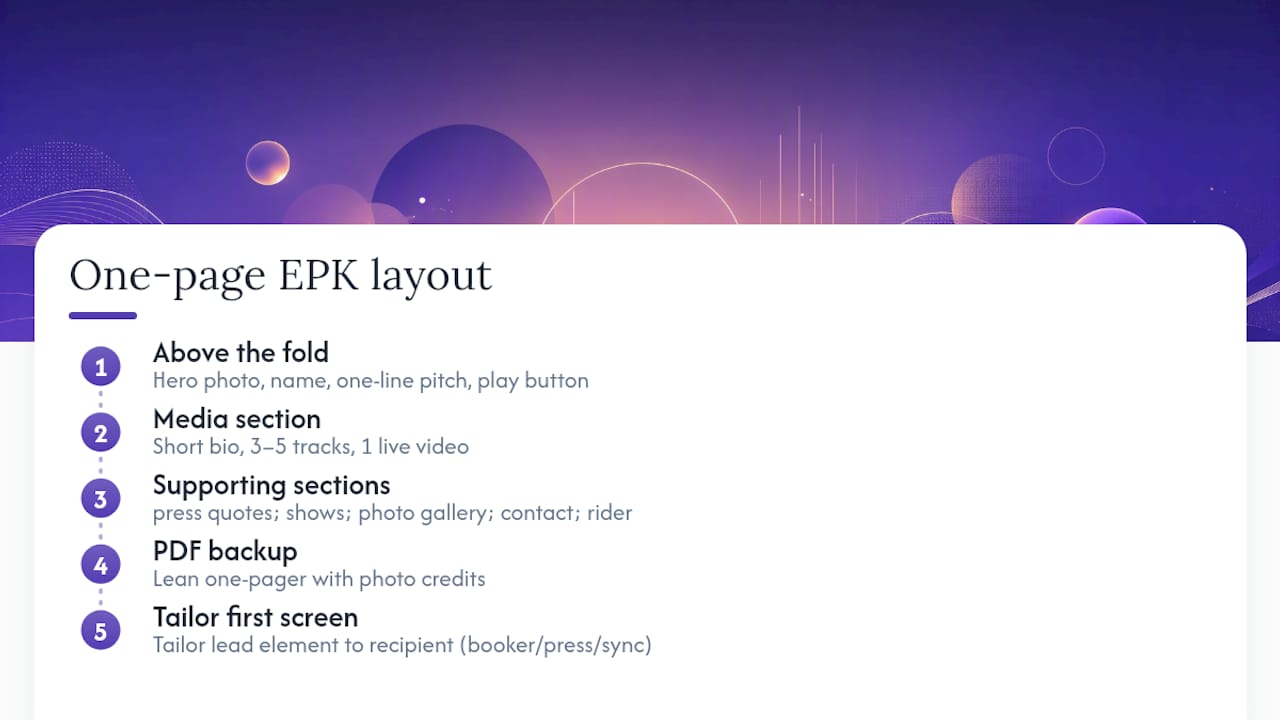
Structure beats decoration every time. Here’s a one-page hosted layout that works across genres:
Above the fold: hero photo, artist name, one-line pitch, embedded play button for your lead track.
Next section: short bio, three to five tracks, one live video.
Following sections: press quotes, recent and upcoming shows, high-resolution photo gallery, contact block, tech rider link.
Sample one-line pitch: “Brooklyn indie-soul trio blending live horns with bedroom-pop production, streaming 40,000 monthly listeners.” That’s specific, scannable, and gives a booker or editor a genre and a proof point in one breath.
Sample short bio (about 80 words): “Marlowe Reyes writes stripped-down folk songs about leaving the town you grew up in. Since 2023, the project has toured the Pacific Northwest, opened for The Head and the Heart at Neptune Theatre, and landed a feature on a regional NPR affiliate. The debut EP, Low Tide, released in 2025, has crossed 60,000 streams. Reyes plays solo or with a full three-piece band depending on the room.”
For the long bio, expand that same arc with more texture: the origin story, a specific creative influence, a couple of named collaborators, and a closing line about what’s next. Save the poetic language for the long version. The short one is a business card.
A PDF backup still earns its place. Some journalists specifically request an attached press kit rather than a link, particularly for print or wire coverage, and a downloadable one-pager with photo credits and a FAQ sheet makes their job easier. Use a hosted page as your primary format and keep a lean PDF version ready to attach when asked.
What goes in the first screen changes by recipient. A venue booker wants your live clip and recent draw numbers front and center. A journalist wants the one-line pitch and your best quote from prior coverage. A sync supervisor wants mood and genre tags plus a note that clean stems are available on request.
An Electronic Press Kit’s core purpose is to remove friction. It exists to give a time-pressed reviewer a fast, credible first impression, not to guarantee airplay, a booking, or a placement. The kit’s job is to make saying yes easy.
Where to Host Your EPK: Builders, Websites, and PDFs Compared
You have three real options for hosting: a dedicated EPK builder, a full website with an EPK page built in, or a PDF you send as an attachment. Each fits a different stage of an artist’s career.
A dedicated hosted builder gets you live fastest. Platforms in this category, including tools like EPKBuilder, are built specifically around the press-kit format: photo galleries, embedded audio players, contact forms, all pre-structured so you fill in the blanks rather than design from scratch. The tradeoff is you’re often locked into their template and, on the free tiers, their branding.
A full website platform, something like Wix, gives you more design control and lets your EPK live alongside a store, tour calendar, and mailing list signup on your own domain. That flexibility costs setup time. You’re designing a page from a blank canvas instead of filling a template, and updates require touching your whole site rather than one profile.
Some players have tried to combine press kit tools with submission marketplaces, an approach services like Sonicbids have taken in the past, pitching festival and gig submissions alongside the kit itself. For most independent artists, though, a platform built around musician networking and gig discovery, not just static hosting, does more long-term work. That’s the gap MyKasu is built to fill: a hosted profile that functions as your EPK and connects you to promoters and collaborators actively looking for artists like you.
Here’s how the categories stack up on the dimensions that actually matter when you’re choosing:
| Dimension | Dedicated EPK builder | Full website | PDF leave-behind |
|---|---|---|---|
| Best for | Press, venues, quick festival submissions | Artists needing a full online presence plus EPK | Journalists who request attachments |
| Features included | Audio/video embeds, press downloads, contact form | Full design control, EPK page, store/calendar options | Static text, images, links only |
| Cost/hosting model | Often freemium, paid tier for custom domain | Free to paid, depends on platform and plugins | Free to produce, no hosting cost |
| Ease of updating | Fast, template-based edits | Slower, requires site-wide edits | Manual, requires re-sending every update |
| Shareability | Public link, easy to drop in emails | Public link, ties into full site navigation | Email attachment only, no live updates |
Decide based on who’s going to use the kit. If you’re pitching venues and press right now, a hosted builder or a musician-focused platform gets you live in under an hour. If you’re building a long-term brand with merch and tour dates, a full site makes more sense, but don’t let site-building perfectionism delay your first pitch. Start with a hosted page. Migrate later if you need more.
On the domain question: a custom domain looks more polished, but a platform URL is perfectly professional at the pitch stage. Web-based press kits update instantly and embed media directly, which is the real advantage over a PDF, whatever the URL looks like. Keep a PDF backup anyway. Some journalists still want an attachment they can archive, and inboxes don’t always render embedded players correctly.
How to Build Your EPK: A Step-by-Step Workflow
You can have a working EPK live in 15 to 30 minutes if your assets are already gathered. Here’s the order that gets you there fastest.
- Gather your files first. Pull your best three to five tracks, one live video clip, and two or three high-resolution photos before you touch any builder.
- Pick your lead track deliberately. This is the song a stranger hears first, so choose your strongest hook, not your most personal song.
- Write your one-line pitch. Genre, a comparison point if useful, and one proof number (streams, shows, press mention).
- Upload everything to your chosen platform. Whether that’s a builder, a website page, or a MyKasu profile, keep the above-the-fold layout tight: photo, pitch, play button.
- Set your contact info and rights details. Email address, ISRC codes, and split sheet if sync is a goal.
- Publish and grab the link.
- Test before you send anything. Open the link on your phone, then in a private browser window to catch any login walls. Sending it to three trusted peers will surface a weak track or a confusing bio line faster than staring at it yourself.
Tailor the pitch email around whatever the recipient cares about most. A venue booker wants your draw and a live clip up top. A journalist wants your one-line pitch and a quote from prior coverage. A sync supervisor wants your metadata confirmed before they’ll open anything else.
Keep pitch emails short. A subject line like “Duo seeking August dates, Pacific Northwest” beats anything vague. Body copy: three to four sentences, genre, proof point, the ask, and the link. Attach a PDF only if the recipient’s submission process specifically requests one; otherwise, a link is faster for everyone.
How Often to Update Your EPK and Which Metrics Matter
Update your EPK at minimum every three months, or immediately after any major milestone: a new release, a notable show, a press hit. Artists who keep their kit current and test it regularly on mobile come across as more credible to bookers and press than artists with a beautifully designed but outdated one.
Pro Tip: Set a recurring calendar reminder for the first Monday of every quarter labeled “audit EPK.” It takes ten minutes and it’s the difference between a kit that helps you and one that quietly costs you bookings.
Show your monthly listener count, recent show attendance, and your most recent press mention, rounded and current. A specific recent number beats a vague historical claim every time. “Sold out the Tractor Tavern in June” does more work than “toured extensively.”
Hide or cut anything stale: a photo from three years ago, a broken link to a defunct blog post, a stat that hasn’t moved since your last update. Outdated material doesn’t just fail to help. It actively signals inactivity, which is worse than showing nothing at all.
To know whether your EPK is actually working, watch three signals: whether recipients open the link at all, whether they play through more than a few seconds of your lead track, and whether you’re getting replies. A kit that gets opened but never played usually has a weak hero screen or a slow-loading player. A kit that gets played but generates no replies usually has a bio or ask that doesn’t land. Fix the layer that’s failing before you touch anything else.
How MyKasu Supports EPK Publishing and Gig Discovery
MyKasu is built specifically for the workflow this guide just walked through: a hosted profile that functions as a living EPK, plus a network built for the people who’ll actually use it.
- Publish a hosted EPK page with embedded audio and video that updates the moment you edit it, no rebuild required
- Attach press assets, credits, and contact info in one place instead of scattering them across a website and a Google Drive folder
- Surface directly to promoters, bookers, and collaborators actively browsing for artists in your genre and city
- Skip the static-file problem entirely: your stats, recent shows, and tracks live on a profile designed to stay current, not a PDF that ages the moment you send it
The community layer is what separates this from a simple hosting page. A static site gets you a link to send. A network gets you found by people you haven’t pitched yet.
What a Working Indie Artist Wishes Beginners Knew
Most guides tell you to include everything you’ve ever done. That’s backwards. The best move is pruning ruthlessly: three to five tracks, one video, one clear ask. A recipient with 40 seconds of attention doesn’t want your discography. They want proof you’re worth a longer look.
Picking your lead track is the highest-leverage decision in the whole kit, and most artists get it wrong by choosing their favorite song instead of their strongest hook. Your favorite song might be a slow-burn album cut that rewards patient listening. Your lead track needs to work in the first 15 seconds for someone who’s never heard of you and has four other emails open.
Timing matters almost as much as content. Send your pitch within a week of a notable show or a press mention, while the proof point is still fresh and verifiable, not three months later when it reads like old news.
Here’s the tip that changes outcomes for booking pitches specifically: a 30 to 90 second live-performance clip showing genuine stage presence usually beats a polished, expensive music video. Bookers aren’t hiring a video director. They’re trying to picture you on their stage in front of their crowd, and a rough phone clip of a packed room reacting to you live tells them more than any studio production ever will.
Get Your EPK Live on MyKasu Today
Everything covered here, the hero screen, the bio lengths, the update cadence, points toward one practical problem: most hosting options make you choose between easy updates and getting discovered by people who book gigs. MyKasu solves both at once, built specifically for music professionals instead of general web hosting.
Sign up, build your profile using the component checklist from this guide, and publish your EPK link in minutes. MyKasu handles the technical upkeep automatically as you swap tracks or add a new show, so your kit stays current without a rebuild every quarter. Once it’s live, drop that single link into every pitch email, festival application, and press outreach instead of managing a PDF that goes stale the day you send it. Start your MyKasu profile and put your EPK where the people booking gigs are actually looking.
Sources
For deeper reading beyond this guide, the Musicians Institute’s EPK guide covers bio length and update cadence in more detail, while Apple for Artists explains why an EPK removes friction rather than guarantees results. StudioBinder’s breakdown of press kit components is useful if you’re building assets specifically for journalists, and the Wikipedia entry on press kits traces how the format evolved from print folders to hosted pages. Test any template on your own phone before you send it. What looks clean on your laptop can break entirely on a recipient’s screen.
- Electronic Press Kit Guide — Musicians Institute
- What is an EPK? — StudioBinder
- Press kit — Wikipedia
- The basics of electronic press kits — EditShare