
The fastest way to get feedback on music that actually improves your next mix or arrangement is simple: ask a listener who can point to a specific section and tell you what to change there, not just how they feel about the whole song. Generic praise like “sounds great” tells you nothing you can act on. A note that says “the second chorus loses energy because the vocal drops out of the top of the mix at 1:42” gives your next session a job.
Three things to do right now:
- Pick one reviewer type for one problem. If you’re unsure the hook lands, ask a peer producer. If you’re unsure the low end is muddy, run it through a technical AI reviewer or send it to a mixing engineer.
- Send a version with context, not a naked file. Include the release stage (demo, near-final, master), what changed since the last pass, and one specific question.
- Ask for a timestamp, always. “What’s weak and where” beats “what do you think” every time.
Two habits will waste your time and the reviewer’s:
- Asking for feedback on an entire album or EP in one message. Nobody gives sharp notes on six songs at once.
- Sending a track to five people with no direction and treating every reply as equally credible, even the ones that just say “fire” or “needs work.”
Key Takeaways
Feedback improves your music only when it names a specific section and hands your next session a concrete task to complete.
| Point | Details |
|---|---|
| Assign reviewers a job | Ask what to listen for (hook, mix, arrangement) instead of “what do you think.” |
| Match reviewer to stage | Peers and producers for early demos, mixing engineers near the final mix, target listeners before release. |
| Demand timestamps | A note tied to a specific second beats a general reaction every time. |
| Filter feedback by credibility and repetition | Weigh source expertise and look for repeated signals before revising. |
| Use MyKasu for structured cycles | Run requests, revisions, and paid reviews inside one project thread instead of scattered messages. |
Table of Contents
- Where to Find Feedback on Your Music
- Who Should Review Your Track, and When?
- How to Ask for Feedback That Gets Specific Answers
- How to Give Feedback That Actually Helps
- How to Decide Which Feedback to Act On
- Templates and a Pre-Send Checklist You Can Use Today
- How a Dedicated Music Network Speeds Up Structured Feedback
- The Pitfalls That Waste Everyone’s Time
- Building a Network You Can Return to Again and Again
- Handling Conflicting Feedback Without Losing Your Direction
- A Producer’s Note on Using Feedback Without Losing the Plot
- Try MyKasu for Structured Feedback and Paid Reviews
- Sources
Where to Find Feedback on Your Music
Different channels are built for different jobs, and confusing them is the single biggest reason artists come away disappointed. A community swap will never replace a trained mixing engineer’s ear, and a paid professional review isn’t the place to test a rough sketch.
Community exchanges, like Reddit’s r/WeAreTheMusicMakers or dedicated swap sites, work on a give-to-get model. RateOurSongs, for example, has users earn credits by reviewing other members’ tracks, and it enforces minimum review length so people can’t just drop a one-word reaction. Expect free, fast, uneven feedback. Some replies will be sharp; others will be a stranger’s mood.
Specialist paid reviewers (mixing engineers, vocal coaches, genre specialists) cost money but deliver focused, credentialed notes. Turnaround is usually days, not minutes, and the depth reflects the price.
AI waveform reviewers analyze the actual audio file and return structured notes. Ratemysong scans a track and produces section-specific comments, a 0 to 100 readiness score, and three prioritized fixes. It’s instant and consistent, but creators often find the numeric score less useful than the accompanying next-step notes, since a score alone doesn’t tell you what to touch first.
Private peer groups (a Discord server, a small circle of trusted collaborators) give you the highest trust and context but the smallest sample size. Good for testing risky creative decisions before wider release.

Professional press and studio reviews, the kind you see from outlets like Pitchfork, model detailed, example-driven critique that ties production choices to audience impact. Independent artists rarely get this tier of coverage pre-release, but studying how these reviews are structured teaches you what a genuinely useful critique sounds like.
| Feedback source | Speed | Depth | Best for |
|---|---|---|---|
| Community exchanges | Fast (hours to days) | Variable | Early gut checks, hook testing |
| Paid specialist reviewers | Slower (days) | High | Mix, master, arrangement problems |
| AI waveform reviewers | Instant | Structured but generic | Technical checks before human review |
| Private peer groups | Fast | High (context aware) | Creative risk testing |
| Professional press models | N/A (study, don’t request) | High | Learning critique structure |
Pro Tip: Run a rough mix through an AI reviewer first to catch obvious technical issues, then send the cleaned-up version to human reviewers so their time goes toward musical judgment calls, not flagging clipping you could have caught yourself.
Who Should Review Your Track, and When?
The right reviewer changes depending on how finished the song is. Asking a mastering engineer to weigh in on a voice memo wastes their expertise. Asking your bandmate to judge a final master’s loudness wastes yours.
At the rough demo stage, you want peer producers and instrumentalists who can catch structural problems while the song is still cheap to change. The question to ask: does the arrangement hold attention?
At the near-finish stage, bring in a mixing engineer or a technically minded peer. The question shifts: does the mix serve the song, or is something masking the vocal or muddying the low end?
Before release, run a pre-release test with actual target listeners, ideally people who resemble your intended audience rather than other musicians. Musicians tend to critique technique; fans react to feeling. Both matter, but they answer different questions.
After release, a post-release reception check with playlist curators, promoters, or engagement data tells you something no pre-release listener can: whether the song holds up against real-world competition for attention.
Feedback works when it gives the next creative pass a specific job. A comment that only tells you how someone felt about the finished song, without pointing at a section, a bar, or a decision, is validation, not critique. That distinction is what separates a review that changes your next session from one that just makes you feel good for an afternoon.
How to Ask for Feedback That Gets Specific Answers
Vague requests get vague answers. The single most important habit here: assign every reviewer a job before they hit play. Tell them what to listen for, whether that’s the hook’s first four bars, the vocal’s clarity in the second verse, or whether the outro overstays its welcome.
Three request formats, depending on the channel:
- The one-line DM, for a peer you already know: “Can you listen to this and tell me if the drop hits at 1:15, or if it needs more buildup first?”
- The community post, for exchanges like r/WeAreTheMusicMakers: state the genre, the runtime, one specific question, and offer a reciprocal review if the platform runs on that model.
- The paid reviewer brief, for a specialist: include the goal (radio-ready mix, sync licensing, live performance), reference tracks you’re aiming near, and any known weak points you already suspect.
Timestamped feedback beats general feedback almost every time. Ask reviewers to note the exact minute and second where something works or doesn’t, and if you’re sending stems, tell them which stems are final versus placeholder so they don’t critique a scratch vocal as if it were the keeper take.
Pro Tip: Send two versions when you’re unsure about a big structural change, the current arrangement and one alternate edit, and ask reviewers which one keeps their attention longer. A side-by-side comparison produces sharper opinions than “what do you think of this” ever will.
How to Give Feedback That Actually Helps
If you’re on the giving end, the same rule applies in reverse. ASCAP’s guidance on feedback draws a useful line between what you personally like and what is effective for the song’s goals. Those are different questions, and good reviewers answer the second one even when their taste says otherwise.
A simple rubric covers most of what matters: does the hook arrive with enough impact, does each section pay off what came before it, is the arrangement clear enough to follow on one listen, does the mix balance vocal against instrumentation, and are the lyrics intelligible where intelligibility matters.
Compare these two responses to the same song:
“I like it, good vibe.” Nothing here points anywhere.
“The hook at 0:48 doesn’t land because the drums drop out right when the vocal needs support. Try keeping the kick and snare through the first hook before pulling back for the second verse.” That’s a next-pass job.
Two to four focused observations beat a ten-point list every time. A creator can act on four specific notes in one session. A creator handed twelve scattered comments usually acts on none of them, because nothing tells them what to fix first.
Keep tone direct but not clinical. You’re pointing at a moment in the song, not grading a test.
How to Decide Which Feedback to Act On
Not every comment deserves a revision. Run new feedback through a short mental checklist before you touch your session file.
- Does the source have relevant credibility? A mixing engineer’s note on low-end clarity carries more weight than a casual listener’s note on the same topic.
- Is this a repeat signal? One person disliking the bridge is an opinion. Three unconnected listeners flagging the same sixteen bars is a pattern.
- Does it align with what you’re actually trying to make? A note that pushes your dark, minimal track toward a radio-pop arrangement might be technically sound and still wrong for your goals.
- What’s the cost of testing it? Swapping a snare sample costs you ten minutes. Re-recording a vocal costs you a session.
When a suggestion is cheap to test and the signal repeats, run a quick A/B: export two versions differing in one variable, share both with a small group, and measure one thing, replay rate, or which version people finish listening to. Don’t test five changes at once; you won’t know which one moved the needle.
And when a comment is well-intentioned but pulls against the reason you made the song in the first place, you’re allowed to set it aside. Protecting your artistic direction isn’t the same as ignoring feedback. It’s choosing which improvements serve the work you’re actually trying to make.
Templates and a Pre-Send Checklist You Can Use Today
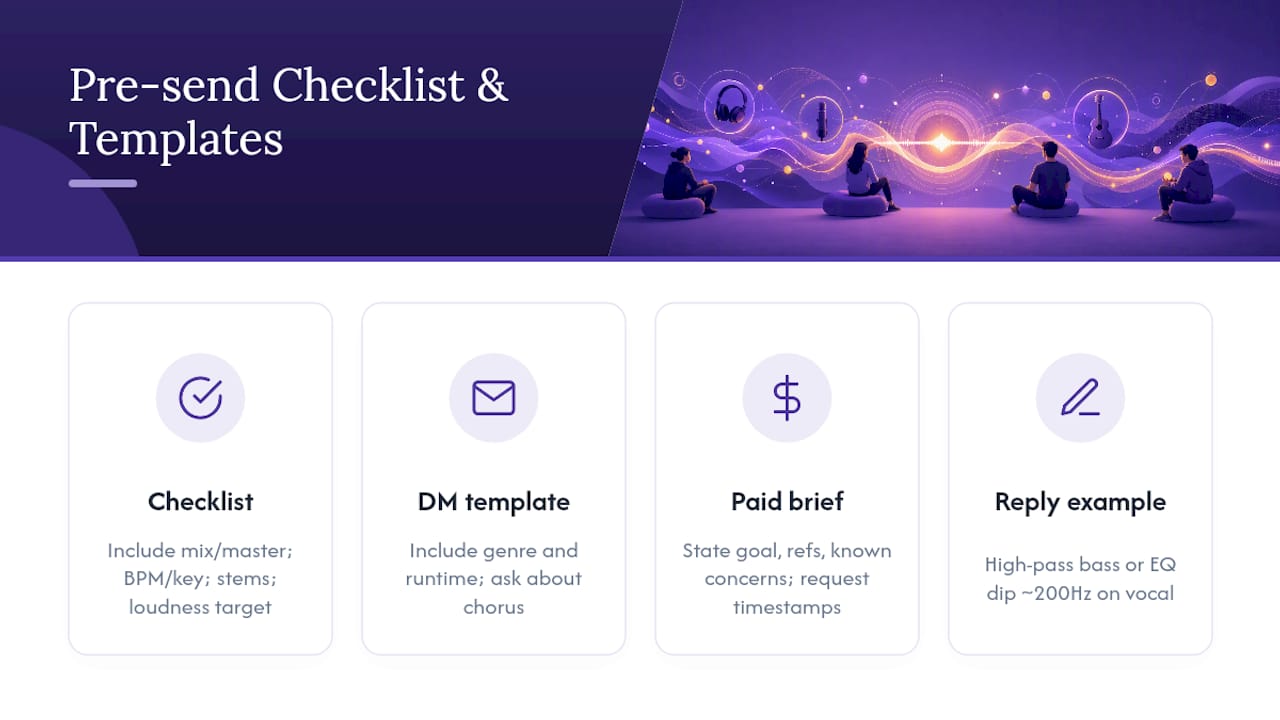
Before sending anything, run through this short list: include the current mix or master, note the BPM and key if reviewers might want them, mention whether stems are available on request, and flag the loudness target if you’re sending a near-final version so nobody mistakes an unmastered file for the finished product.
Short DM template: “Hey, working on a track in [genre]. Runtime’s [X:XX]. Can you tell me specifically whether the chorus at [timestamp] holds your attention, or where it loses you?”
Community post template: “[Genre] track, [runtime], looking for feedback on the arrangement, specifically whether the bridge earns its place. Happy to review two tracks in exchange.”
Paid reviewer brief template: “Goal: [radio mix / sync pitch / live set opener]. Reference tracks: [names]. Known concerns: [specific section or element]. Please timestamp anything that stands out, good or bad.”
A useful reviewer reply models the same specificity back: “Vocal sits well through verse one. At 1:20 the bass and vocal occupy the same frequency range and the lyric gets buried. Try a high-pass on the bass or a slight EQ dip around 200Hz on the vocal.” That reply gives the next session exactly one clear move.
If you’re prepping a track for playlist pitching after your feedback rounds are done, reviewing your final mix against a partner’s playlist promotion guidance before submission can catch issues curators notice immediately.
How a Dedicated Music Network Speeds Up Structured Feedback
Most of the friction in getting good feedback isn’t a lack of willing listeners. It’s finding the right listener, keeping track of which version they reviewed, and organizing paid reviews without juggling five different apps. A network built specifically for music professionals removes most of that friction by design.
On MyKasu, the features that matter for feedback cycles work together instead of scattered across tools:
- Targeted connections let you find reviewers by role, mixing engineers, vocal coaches, genre specialists, instead of posting into a general feed and hoping the right person sees it.
- Project threads keep every version of a track, every comment, and every revision note attached to one conversation, so nobody’s critiquing an outdated file by mistake.
- Request templates built into the platform prompt reviewers to answer the questions that matter, not just react generally.
- A paid-review workflow lets you commission a specialist’s time directly, with expectations set upfront instead of negotiated over email.
Picture two quick scenarios. A producer finishing a near-final mix posts it in a project thread, tags it for mixing engineers specifically, and gets timestamped notes on low-end buildup within two days, all inside one thread instead of scattered across three inboxes. A songwriter testing a new hook posts a short clip to a peer group focused on top-line writing, asks one direct question about the melody’s memorability, and gets three focused replies instead of twenty vague reactions.
Chris Virtuoso, contributing to this piece, has watched enough feedback cycles go sideways from disorganization alone to know that the platform matters almost as much as the reviewer.
The Pitfalls That Waste Everyone’s Time
The most common mistake is overloading listeners. Sending a full album with the message “thoughts?” guarantees shallow feedback, because no one can hold six songs’ worth of detail in their head at once. Break requests into single tracks, or at most one focused question per song if you’re sharing several at once.
The second mistake is ignoring the source mismatch. Feedback from a casual fan about your kick drum’s transient shape isn’t useless, but it’s not the same weight as a mixing engineer’s note on the same issue. Treating every comment as equally authoritative, regardless of who gave it, is how artists end up chasing changes that never should have made the cut.
A third pitfall: asking for feedback too early or too late. A voice memo doesn’t need a mastering engineer’s ears, and a finished master doesn’t benefit from a stranger’s opinion on whether the second verse should exist at all. Match the ask to the stage.
Building a Network You Can Return to Again and Again
One-off feedback requests to strangers work in a pinch, but the artists who improve fastest build a small, recurring circle of trusted reviewers whose taste and expertise they understand over time. That familiarity changes what a comment means. If a reviewer who usually loves your dense arrangements suddenly flags a section as cluttered, that carries more weight than the same comment from someone you’ve never worked with.
Building that circle takes reciprocity. Review other people’s work with the same specificity you want back, and stay active in the same two or three communities rather than posting once and disappearing. Platforms built around ongoing professional relationships, rather than one-time swaps, make this easier to sustain because the same people keep showing up in your project threads instead of vanishing after a single exchange.
Handling Conflicting Feedback Without Losing Your Direction
Two trusted reviewers disagreeing on the same section isn’t a failure of the process. It usually means the section is genuinely ambiguous, or that each reviewer is applying a different standard, one judging commercial potential, the other judging artistic risk.
When notes conflict, ask what standard each reviewer was applying. A mixing engineer flagging a vocal effect as “unclear” is making a technical judgment. A friend calling the same effect “weird” might be reacting to an unfamiliar stylistic choice, not a technical flaw. Those aren’t the same kind of note, and they don’t deserve the same response.
Your artistic vision is the tiebreaker, not the majority vote. If three people love a change that moves the song away from what you’re trying to say, and one person’s note protects that intent, the one note might matter more. Feedback should sharpen your direction, not replace it with a compromise nobody actually wanted.
A Producer’s Note on Using Feedback Without Losing the Plot
The best revision in one of my recent sessions came from a single comment: a peer told me the bridge “felt like a different song wearing the same outfit.” That’s not a technical note, but it pointed straight at a real problem, the transition lacked a musical bridge element connecting the two sections’ energy. One rewritten four-bar passage fixed it.
The micro-advice worth repeating every session: before you send a track out, write down the one question you actually need answered. If you can’t name that question, you’re not ready to ask for feedback yet, you’re ready to keep working.
And one boundary worth holding onto: feedback should sharpen the song you’re making, not replace it with the song someone else would have made instead.
Try MyKasu for Structured Feedback and Paid Reviews
MyKasu solves the coordination problem that makes feedback cycles drag on: instead of chasing reviewers across DMs, group chats, and email threads, you run the whole cycle, request, revision notes, follow-up, inside one project thread built for exactly that purpose.
What that looks like in practice:
- Post a project and connect directly with mixing engineers, producers, and vocal specialists who match your genre and goals.
- Use built-in request templates so reviewers answer the specific questions you need, not generic reactions.
- Access paid-review options when you need a specialist’s focused time rather than a peer’s casual opinion.
- Keep every version and every comment attached to one thread, so nothing gets lost between revisions.
MyKasu is free to join, with premium features available for artists who want promoted visibility or additional paid-review access. If you’re ready to stop guessing who to send your next track to, create a project on MyKasu and start your first feedback cycle today.
Sources
- Ratemysong
- Rateoursongs
- How to Give Better Song Feedback — ASCAP
- New Albums & music reviews — Pitchfork