
The fastest way to find a music producer who fits your sound is to start on MyKasu, a network built specifically for music professionals, because it lets you audition a producer’s actual work and read their release history before you ever send a message. Marketplaces optimize for volume. MyKasu optimizes for fit.
Here’s what to do in the next 72 hours:
- Search profiles by genre and credits. Look for producers whose recent work sits close to your target sound, not just anyone with a slick bio.
- Listen to stems or reference mixes, not just polished singles. Raw stems tell you more about a producer’s actual skill than a mastered final track ever will.
- Send a short, specific brief. Two or three sentences on your sound, your timeline, and your budget range beats a vague “let’s collab” message every time.
Before any of that, set a number. Not a wish, a number. Costs vary widely by producer experience and project scope, and going into outreach without a budget in mind is how artists end up in awkward, drawn-out negotiations three messages deep.
Key Takeaways
The fastest, safest path to hiring a music producer combines a curated platform like MyKasu with disciplined vetting, a paid test, and a written contract before real money changes hands.
| Point | Details |
|---|---|
| Start with a curated community | Search verified profiles and full audio projects on MyKasu before considering marketplaces. |
| Vet through finished credits | Prioritize producers with a consistent catalog of released, credited songs over big single placements. |
| Run a paid test first | Commission a small, paid trial to check communication, speed, and how they handle your vocals. |
| Put terms in writing | Lock deliverables, revisions, ownership, and payment milestones into a simple contract before work starts. |
| Budget honestly, upfront | Set a real number before outreach, since pricing varies widely by experience and platform. |
| MyKasu as the starting point | Use MyKasu’s verified credits and audio previews to filter for genre fit and request a paid test directly through a profile. |
Table of Contents
- Where to Find a Music Producer: The Channels That Actually Work
- How Do You Vet a Music Producer Before Hiring?
- How Much Does It Cost to Hire a Music Producer?
- The Hiring Process, Step by Step
- How MyKasu Helps You Find the Right Producer
- What an Industry Insider Actually Thinks About Finding a Producer
- Start Your Search on MyKasu Today
- Sources
Where to Find a Music Producer: The Channels That Actually Work
Every channel for finding a producer trades off speed, cost, curation, and how likely it is to turn into a real working relationship. Knowing which trade-off you’re making up front saves you weeks of dead-end conversations.
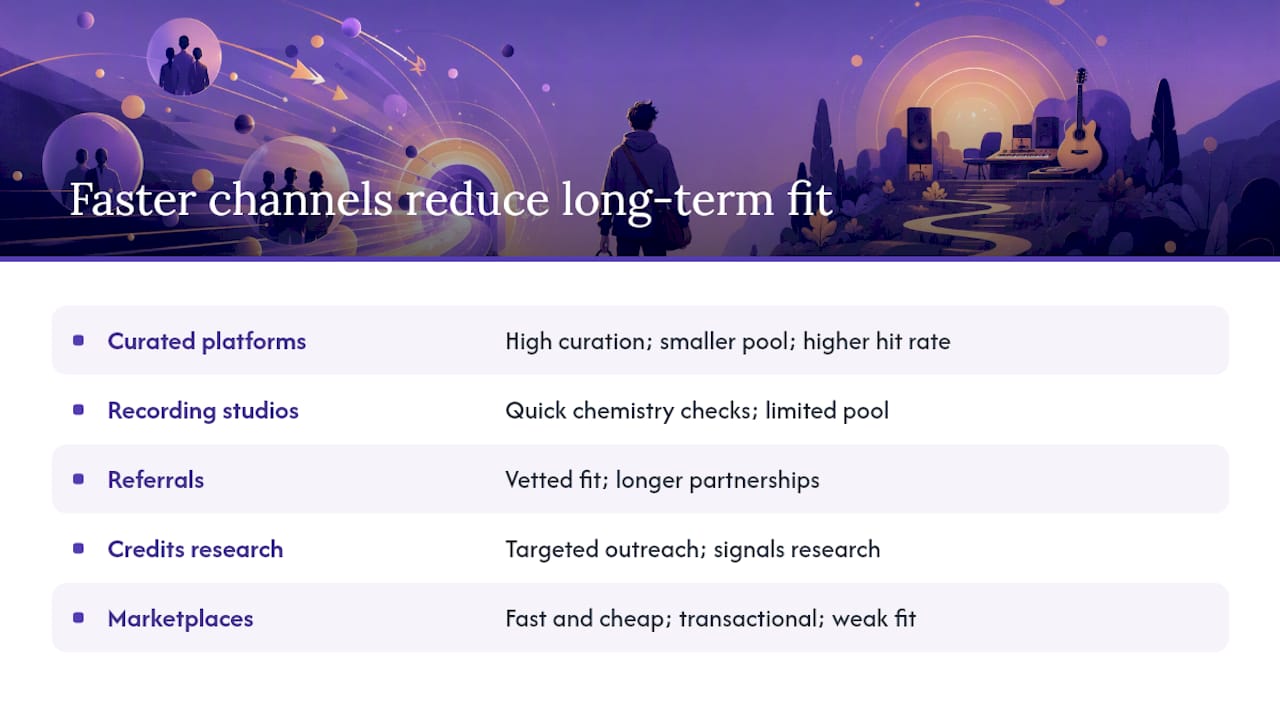
Curated music communities and niche networks. Platforms built specifically for music professionals, like MyKasu, let you filter by genre, listen to full projects, and check who a producer has actually worked with. You’re trading a slightly smaller pool for a much higher hit rate.
Recording studios and local scenes. Walking into a studio or showing up at local shows still works, especially if you’re in a city with an active scene. You get in-person chemistry checks fast, but the pool is limited to whoever’s around.

Referrals from other musicians. Ask any artist you respect who produced their last release. Referrals consistently outperform cold outreach because someone has already vetted the working relationship for you, and smaller creative communities tend to produce longer-lasting creative partnerships than one-off marketplace gigs.
Credits research on tracks you admire. Pick five songs that sound close to what you’re chasing, look up who produced them, and reach out directly. Many producers respond to a specific, well-researched message far more readily than a generic inquiry, because it signals you actually did your homework.
Marketplaces and gig sites. Fast, transactional, and useful when you need a quick turnaround on a single beat or mix. What you gain in speed you often lose in long-term fit, since marketplaces are built around volume rather than curated taste.
How Do You Vet a Music Producer Before Hiring?
Vetting is where most independent artists rush, and rushing here is what leads to blown budgets and half-finished tracks. A producer shapes arrangement, guides your performance, and coordinates the entire recording and post-production process, so the stakes on a bad match are higher than most first-timers expect.
Run through this before you commit:
- Listen for consistency, not just polish. A single great song can be a fluke. A catalog of finished releases that all sound intentional is not.
- Check for real credits. Search their name alongside the artists they claim to have worked with. If you can’t verify it anywhere, that’s a gap worth asking about directly.
- Ask about repeat collaborators. Producers who get asked back by the same artists tend to be easier to work with than their portfolio alone suggests.
- Confirm availability against your timeline. A producer juggling five album deadlines this month isn’t going to give your single track real attention.
- Request a short call or voice memo exchange. Chemistry matters. Stylistic fit and working chemistry often matter more than a high-profile credit list, and you can’t gauge chemistry from a bio alone.
Once you’re on a call, ask these directly:
- What does your creative process actually look like from first session to final delivery?
- What’s included in your deliverables? Stems, trackouts, a rough mix, a final master?
- How many rounds of revisions are built into your rate?
- Who owns the masters, and how are publishing splits handled?
- Do you bring in session musicians, and is that cost separate?
- Are you handling the mix and master yourself, or is that a separate step with someone else?
Asking about process, timeline, and who handles mixing and mastering before you hire is one of the simplest ways to avoid scope creep once the project’s underway.
Watch for these red flags:
- The conversation goes straight to money before either of you has discussed the song.
- Vague or evasive answers about who owns the final files.
- No verifiable credits on any finished, released song.
- Refusal to do a short paid test before a full project commitment.
- A producer who pitches you a fixed sonic direction before hearing a single demo. Industry veterans consistently flag this as a warning sign. The strongest producers listen first and shape their approach around your voice, not the other way around.
How Much Does It Cost to Hire a Music Producer?
There’s no fixed industry rate for producer work. Pricing depends heavily on the producer’s experience level, the scope of your project, and which platform you’re using to connect, which is exactly why transparency about your budget matters from message one.
Most producers charge under one of these models:
- Flat project fee. One price for the whole song or EP, agreed on before work starts.
- Per-track fee. A set rate for each individual song, useful when you’re building out a full project over time.
- Hourly or session rate. Common for studio time and mixing work, less common for full creative production.
- Points on masters. A percentage of future royalties instead of, or on top of, an upfront fee. More common with established producers working on higher-stakes projects.
- Hybrid deposit plus milestones. A partial payment up front, with the rest tied to specific deliverables.
Think in tiers rather than fixed numbers. Entry-level producers building a catalog often charge less and offer flexibility, but expect fewer built-in revisions. Mid-tier producers typically bring a stronger track record and tighter turnaround, at a proportionally higher rate. Professional-tier producers with strong catalogs command premium rates, usually justified by faster delivery, established mixing chops, and industry connections. Treat all of this as directional. Your actual number depends entirely on who you’re talking to and what you’re asking for.
A few tactics stretch a small budget further without gutting quality:
- Start with a single paid trial track before committing to a full project or EP.
- Lock scope in writing before work begins, including exact number of revisions.
- Split payment into a deposit plus milestone-based installments tied to actual deliverables.
- Negotiate mixing, mastering, and session players as separate line items so you can trim what you don’t need yet.
Pro Tip: Get ownership and credit terms in writing before a single note is recorded. A five-minute conversation about who owns the masters now saves months of legal back-and-forth later.
The Hiring Process, Step by Step
A predictable hiring flow protects both your budget and your timeline. Here’s the sequence that keeps projects from stalling out halfway through:
- Discovery. Find and shortlist two or three producers whose work matches your target sound.
- Paid test or sample. Commission a short, paid trial, even just a rough beat or a two-minute mix pass, to see how they work.
- Scope and estimate. Get a written breakdown of deliverables, timeline, and total cost before agreeing to anything.
- Written agreement. Put deliverables, revisions, ownership, and payment terms on paper. Verbal agreements fall apart under pressure.
- Deposit. Pay an agreed percentage up front to lock in the schedule.
- Production milestones. Check in at rough draft, arrangement lock, and pre-mix stages rather than waiting for a surprise final file.
- Mix. Confirm who’s handling it and what format you’ll receive stems in.
- Approval. Review against the original scope, not a shifting set of expectations.
- Final payment and delivery. Release the balance once you’ve received everything the agreement specifies.
A single track with a straightforward arrangement typically moves faster than a full EP with layered instrumentation, guest vocalists, or multiple genre influences. Build extra time into any project involving live musicians or complex arrangements. It always takes longer than the calendar suggests.
Your contract, even a simple one, should cover:
- Exact deliverables (stems, trackouts, final mix, final master)
- Number of included revision rounds and cost of additional rounds
- Full payment schedule tied to milestones
- Ownership of masters and stems
- Publishing split percentages
- Production and songwriting credits
- Confidentiality, if the project is unreleased or sensitive
- What happens if either side wants to walk away mid-project
When you run a paid test, keep it small and specific: one section of a song, a two-week turnaround, and a clear deliverable like a rough mix or a beat with stems. Evaluate it on communication speed, how closely the result matches your brief, and whether the producer asked good questions before diving in.
How MyKasu Helps You Find the Right Producer
MyKasu surfaces producers through actual audio, not just claims. Every profile is built around portfolio previews, verified credits, and endorsements from other music professionals who’ve actually worked with that person, so you’re vetting real evidence instead of a polished sales pitch.
Search filters let you narrow by genre and experience level, which cuts out a huge amount of the manual digging that credits research or cold DMs usually require. When you find a profile that fits, you can request stems or a reference mix directly through the platform before committing to anything larger.
A few things to check on any MyKasu profile before reaching out:
- Full audio projects and stems, not just a highlight reel.
- Verified credits and release history tied to real songs.
- Endorsements or testimonials from other musicians and engineers.
- Whether the producer explicitly offers a trial or short paid test.
- Clear, upfront language about pricing and payment structure.
Pro Tip: Filter for producers who list specific deliverables (stems, trackouts, mix revisions) directly in their profile. Producers who spell out deliverables up front tend to be far more organized once a project actually starts.
What an Industry Insider Actually Thinks About Finding a Producer
Every artist wants to work with the producer whose name is on their favorite record. Almost none of them need to. The gap between “impressive credit list” and “right producer for your song” is bigger than most independent artists realize, and closing that gap usually has nothing to do with chasing a bigger name.
I’ve watched artists spend months trying to get a reply from a producer with a stacked discography, only to hand their song to someone with three finished tracks and genuine chemistry, and get a better result in half the time. The finished catalog matters more than the size of the names attached to it. A producer with five polished, intentional-sounding releases and real communication skills will usually outperform a producer with one huge placement and a spotty track record everywhere else.
The instinct to look for a big name is understandable. It’s also usually the wrong instinct. Community-driven discovery, where you can actually hear a producer’s range and see who vouches for them, consistently produces better matches than chasing whoever’s trending. That’s the entire logic behind a platform like MyKasu: it treats fit and verified work history as the signal, not follower counts.
Start Your Search on MyKasu Today
There are other routes into a producer’s inbox. Cold DMs on social media, marketplace gig boards, hoping someone at a local show hands you a business card. All of them work occasionally. None of them give you what MyKasu does: verified profiles, real audio you can audition before you ever send a message, and a community built entirely around music professionals looking to collaborate.
Before you search, have three things ready: a short demo or reference track, a one-paragraph project brief, and a realistic budget range. Then search MyKasu by genre and listen through a few full projects, not just singles. When you find someone whose sound lines up, request a short paid test through their profile before committing to anything bigger.
Some producers on MyKasu offer featured availability for artists looking to move quickly, and the platform’s growing base of verified profiles keeps expanding across genres. Create your profile on MyKasu and start listening.
Sources
- How to Choose a Producer That’s Right for You – Spotify for Artists
- How to Find the Right Music Producer - Berklee Online Take Note
- How to Find the Right Music Producer (2026 Guide) – The AirGigs Music Production Blog
- Where to Find a Good Music Producer (2026 Guide From an Industry Producer)