

The fastest way to find a singer is to post a focused project brief with a 30–60 second instrumental clip across two or three channels simultaneously, then give every candidate the same short audition task. That combination cuts response time and makes comparison straightforward. Here’s where to start right now:
- Dedicated music marketplaces (Vocalizr, SoundBetter, AirGigs): highest quality pool, fastest audition workflow
- Freelance platforms (Fiverr): wide price range, quick turnaround, quality varies
- Music community networks (MyKasu): targeted music-pro audience, audio-first profiles, free to join
- Social platforms (Instagram, TikTok, YouTube): great for discovering vocalists with an existing sound and audience
- Local scenes (open mics, music schools, studio referrals): best for in-person sessions and long-term collaborators
Post your clip and brief today. If you get no responses within 48 hours, your brief needs work or your channel mix is off.
Key Takeaways
The most reliable way to find a singer is to combine a focused brief with a short audition task, post across two or three channels simultaneously, and run a paid test session before committing to any split arrangement.
| Point | Details |
|---|---|
| Prepare your brief first | Include genre, BPM, key, vocal role, payment model, and a 30–60 second clip before posting anywhere. |
| Mix your channels | Post on one dedicated marketplace, one community platform, and send one targeted cold DM for the fastest response. |
| Use identical audition tasks | Give every candidate the same short task to compare voices fairly and reduce bias toward demo polish. |
| Run a paid test session | Pay for one verse or chorus before agreeing to a full split; it validates files, timing, and communication quality. |
| Document rights in writing | Specify usage rights, exclusivity period, credits, and termination terms in a short written agreement before recording starts. |
| Use MyKasu | Post your project on MyKasu to reach a targeted pool of music professionals with audio-first profiles and direct messaging. |
Table of Contents
- Where can you find singers online and offline?
- What should your project brief include to get real responses?
- How do you audition singers and pick the right one?
- What files do you send and receive for a remote session?
- How should you handle payment and rights agreements?
- How do you find singers willing to collaborate for free or a split?
- Ready-to-use outreach messages and audition prompts
- What red flags should you watch for before hiring?
- How MyKasu helps you find and hire singers faster
- Legal considerations beyond payment and credits
- MyKasu connects you with the right singers, faster
- Sources
Where can you find singers online and offline?
The Tools 4 Music producer guide and Unison’s roundup of singer platforms both point to the same core insight: no single channel wins for every project. The right mix depends on your budget, timeline, and genre.
-
Dedicated singer marketplaces (Vocalizr, SoundBetter, AirGigs): These are the highest-signal channels for producers. Vocalizr lets you post a project and receive auditions directly. SoundBetter skews toward professional session vocalists, with typical session rates for experienced singers vary widely, often reflecting the professional session vocalist market. AirGigs sits in between. Use these when you need professional-grade results and have at least a modest budget.
-
Freelance platforms (Fiverr): Fiverr’s singers category shows wide price variation and fast-turnaround options, making it useful for quick demos or budget projects. Quality is mixed compared to specialized music marketplaces, so always request a raw sample before committing.
-
Music community networks (MyKasu, BeatStars): Platforms built specifically for music professionals give you a more targeted pool than general freelance sites. Everyone on the platform is there for music, which filters out a lot of noise.
-
Social platforms (Instagram, TikTok, YouTube): Search hashtags like #singersongwriter, #vocalcover, or genre-specific tags. TikTok is particularly useful for finding vocalists with a proven audience and a clear sonic identity. Expect slower response rates from cold DMs, but the quality ceiling is high.
-
Discord and Reddit: Communities like r/WeAreTheMusicMakers or genre-specific Discord servers are active with singers seeking collaboration. Free or split-based deals are the norm here.
-
Local open mics and music schools: The underrated option. A singer you’ve heard live already has a proven tone and stage presence. Music school bulletin boards and faculty referrals often surface serious students willing to work for competitive rates or splits.
-
Studio referrals: Ask your mixing engineer or recording studio who they’ve worked with recently. A referral from someone who has heard the singer in a professional context is worth ten cold auditions.
Cost shape at a glance:
- Free or split-based: Discord, Reddit, local scenes, music schools
- Pay-per-session (budget to mid-range): Fiverr, Vocalizr
- Professional session rates: SoundBetter, AirGigs, studio referrals
Producers get faster, higher-quality replies when they combine one dedicated marketplace post with one social post (audio clip) and one private outreach to targeted singers. Running all three simultaneously is more efficient than waiting on one channel at a time.
What should your project brief include to get real responses?
Before you post anywhere, nail down six things: genre and subgenre, vocal range and tone, vocal presentation (male/female/non-binary), the singer’s role (topline writer vs. featured vocalist), payment model, and your timeline. Skipping any of these is the most common reason briefs get ignored.
Mandatory brief fields:
- Genre and subgenre (e.g., “dark pop, think Billie Eilish meets Lorde”)
- BPM and key
- Vocal role: topline (melody + lyrics) or featured (sing existing lyrics)
- Range and tone descriptors (e.g., “warm alto, breathy lower register”)
- Payment model: flat session fee or royalty split
- Timeline: when you need the first take, and final delivery date
- Deliverables: dry lead vocal, harmonies, ad-libs, file format
Fill-in-the-blanks brief template:
Audition task examples:
- Sing the chorus of the attached clip using your own melody and phrasing (30–60 seconds, dry recording, no effects).
- Write and record a short topline idea over the first 16 bars.
- Record a harmony part over the provided guide vocal.
To grade submissions, score each on four axes: pitch consistency, tone fit, emotional delivery, and recording quality. A simple 1–5 scale per axis takes under two minutes per submission and makes comparison objective.
Pro Tip: Include the 30–60 second clip in the brief itself, not as a follow-up. Singers decide whether to audition based on the music, and a missing clip is the single biggest reason qualified vocalists skip your post.
How do you audition singers and pick the right one?
The goal of an audition is not to find the most technically perfect singer. It’s to find the voice that fits this record. Those are different things, and confusing them is how producers end up with a technically flawless vocal that sounds wrong on the track.
Audition checklist:
- Listen to at least five recordings from each candidate before shortlisting
- Request at least one raw or live performance (no heavy production)
- Confirm their range covers the part you need
- Check pitch consistency across multiple takes, not just the best one
- Assess emotional delivery: does the performance feel like something?
- Verify home-recording quality is workable (not perfect, just usable)
- Note response time and communication quality during the audition process
Running a comparative audition:
Give every candidate the same short task, identical brief, same clip. This is the single most effective way to make apples-to-apples comparisons and reduce bias toward demo polish over raw suitability. Score each submission on four to six axes: range fit, pitch, tone, delivery, timing, and recording quality. A spreadsheet with one row per candidate and one column per axis takes ten minutes to set up and saves hours of second-guessing.
Reading the trade-offs:
A singer with perfect pitch but a thin tone may not serve a dense, layered production as well as a singer with slightly imperfect pitch and real character. On a sparse acoustic track, the math flips. Know what the record needs before you start scoring, or you’ll optimize for the wrong thing.
Numbered scoring also helps when you’re choosing between two finalists who are genuinely close. If candidate A scores higher on tone and delivery but lower on pitch, and the track has heavy melodic content, pitch wins. If the track is more rhythmic and conversational, delivery wins.
What files do you send and receive for a remote session?
Remote sessions fail most often not because of talent, but because of file confusion. A clear handoff protocol fixes this before it becomes a problem.
Files to send the singer:
- Reference mix (MP3 is fine, clearly labeled)
- Instrumental stem(s) (WAV, no effects on the vocal bus)
- Click track or tempo map (especially if the track has tempo changes)
- Key and BPM in the file name and in a short text note
- Guide vocal (dry, no reverb or delay) so the singer knows the intended phrasing
- Lyric sheet with any pronunciation notes for unusual words or phonetics
Files to request back:
- Dry lead vocal, multiple takes (not comped by the singer unless agreed)
- Comped lead vocal (if you want their preferred take)
- Harmony stems (separate files per harmony part)
- Ad-libs (separate file)
- All files as 24-bit WAV at the same sample rate as your session (48 kHz is standard for most DAWs)
File naming example:
TrackName_LeadVocal_Take01_48k24bit.wavTrackName_Harmony_High_Take01_48k24bit.wav
Pro Tip: In your session notes, include the exact sample rate and bit depth you’re working at. Mismatched sample rates cause pitch and timing drift that’s easy to miss until mix stage. One line in your brief prevents hours of troubleshooting.
How should you handle payment and rights agreements?
Payment conversations are where most producer-vocalist relationships either solidify or fall apart. The fix is to bring it up early, be specific, and put it in writing.
Common payment models:
- Flat session fee (work-for-hire): You pay a set amount; the singer delivers the vocal and has no ownership claim. Clean, simple, preferred for commercial or sync-targeted work. Rates vary widely by experience and platform.
- Royalty split: No upfront fee; the singer receives a percentage of composition and/or master royalties. Common in independent releases where budget is tight. Specify whether the split covers the composition, the master, or both.
- Mixed model: A modest upfront fee plus a smaller split. Reduces the singer’s risk while keeping your upfront cost lower than a full session rate.
Essential agreement points:
- Deliverables (exactly what files, how many takes)
- Usage rights (which platforms, territories, commercial use)
- Credits (how the singer is credited on streaming platforms and releases)
- Payment schedule (upfront, on delivery, or milestone-based)
- Exclusivity period (can the singer release their own version?)
- Termination terms (what happens if either party pulls out before delivery)
Plain-language agreement template:
Pro Tip: For any split arrangement above a modest percentage, or for sync-targeted tracks, use a simple contract service or consult a music attorney. A one-page agreement reviewed by a professional costs far less than a dispute after a track gets licensed.
How do you find singers willing to collaborate for free or a split?
Budget-free collaboration is legitimate and common in independent music, but it works only when both sides are getting something real out of the deal.
Where to find split-based collaborators:
- Discord music production servers (r/WeAreTheMusicMakers Discord, genre-specific servers)
- Reddit threads (r/WeAreTheMusicMakers, r/singing, genre subreddits)
- Music school bulletin boards and student showcases
- Local open mic nights (approach singers after their set)
- Community platforms and music networks where members actively seek collaboration
How to structure a fair trade offer:
Be specific about what you’re offering in return. “Exposure” is not a trade. Concrete trades include: full production and mixing, engineering credits on the release, co-writing credit, a percentage of streaming revenue, or promotion to your existing audience. State the trade clearly in your initial message and document it in a short written memo before any recording starts.

Quality expectations and avoiding abuse:
Unpaid collaboration works best when both parties have comparable experience levels and genuine creative alignment. If you’re asking a professional-level vocalist to work for free while you plan to monetize the track, expect rejection. If you’re offering a genuine creative partnership with a fair split and real release plans, you’ll find takers. The red flag on your end: asking for unlimited revisions, multiple songs, or full buyout rights in exchange for “exposure.”
Ready-to-use outreach messages and audition prompts
Short messages get more replies. Singers receive a lot of outreach, and a long paragraph with no audio is the fastest path to being ignored.
Cold DM template (social or platform):
Public job post template:
Audition prompt examples:
- “Record 30–60 seconds over the attached clip. Use your own melody and phrasing. Dry vocal only, no reverb.”
- “Write and record a short hook idea over the first 16 bars. Lyrics are optional at this stage.”
- “Sing the provided guide vocal melody in your own style. Show us your tone, not your production.”
Quick scoring rubric:
| Criterion | Weight |
|---|---|
| Tone fit | High |
| Pitch consistency | High |
| Emotional delivery | Medium |
| Recording quality | Low |
Message etiquette: Keep the initial message under 100 words. State the payment model in the first message, not as a follow-up. End with a single clear next step (“send a 30-second clip” or “reply if interested”). Ambiguous next steps kill reply rates.
What red flags should you watch for before hiring?
Most hiring mistakes are visible before you commit. The signals are just easy to rationalize away when you’re excited about a voice.
Red flags to take seriously:
- No raw or live recordings available, only heavily produced demos
- Evasive or vague answers about payment, rights, or deliverables
- Refusal to sign even a simple one-page agreement
- Inconsistent communication: slow replies, missed deadlines during the audition itself
- Requests for full payment upfront with no track record or reviews
- Overpromising on turnaround time without asking about your session specs
Final selection tips:
Pick the candidate who fits the record’s vibe and can deliver on your timeline over the technically superior singer who communicates poorly or takes three days to reply to a simple question. A great vocal delivered late is a production problem. A good vocal delivered on time and with clear communication is a finished record.
When two finalists are genuinely close, the tiebreaker is almost always communication quality during the audition. The singer who asks smart questions about the track, requests the guide vocal, and delivers the audition task cleanly is showing you exactly how the session will go.
Pro Tip: Run a single paid test session before committing to a full split arrangement. Pay for one verse or chorus, evaluate the full delivery chain (files, format, timing, quality), and then decide. It costs less than a dispute mid-project.
How MyKasu helps you find and hire singers faster
MyKasu is a dedicated social network for music professionals, which means the pool you’re searching is already filtered. Every profile belongs to someone in the music industry: producers, vocalists, engineers, promoters. That alone removes the noise you get on general freelance platforms.
Features relevant to finding singers:
- Project posts with audio sharing so singers can hear your track before responding
- Searchable profiles filtered by role, genre, and location
- Gig listings for both paid sessions and collaboration opportunities
- Direct messaging for outreach and negotiation
- Networking tools that surface mutual connections and past project activity
Sample workflow on MyKasu:
- Create your profile and upload a project post with your 30–60 second clip and brief
- Browse singer profiles using genre and role filters; shortlist candidates based on their audio demos
- Send a short DM using the cold outreach template above
- Schedule a paid test session with your top two or three candidates
- Agree terms in writing, collect deliverables in the specified format
Pro Tip: On MyKasu, check a singer’s activity level and past project posts before reaching out. A profile with recent uploads and active connections signals someone who is currently working and responsive. A dormant profile, even with strong demos, is a reliability risk.
Legal considerations beyond payment and credits
Payment and credits are the starting point, not the finish line. Several contract clauses matter just as much and get skipped far more often.
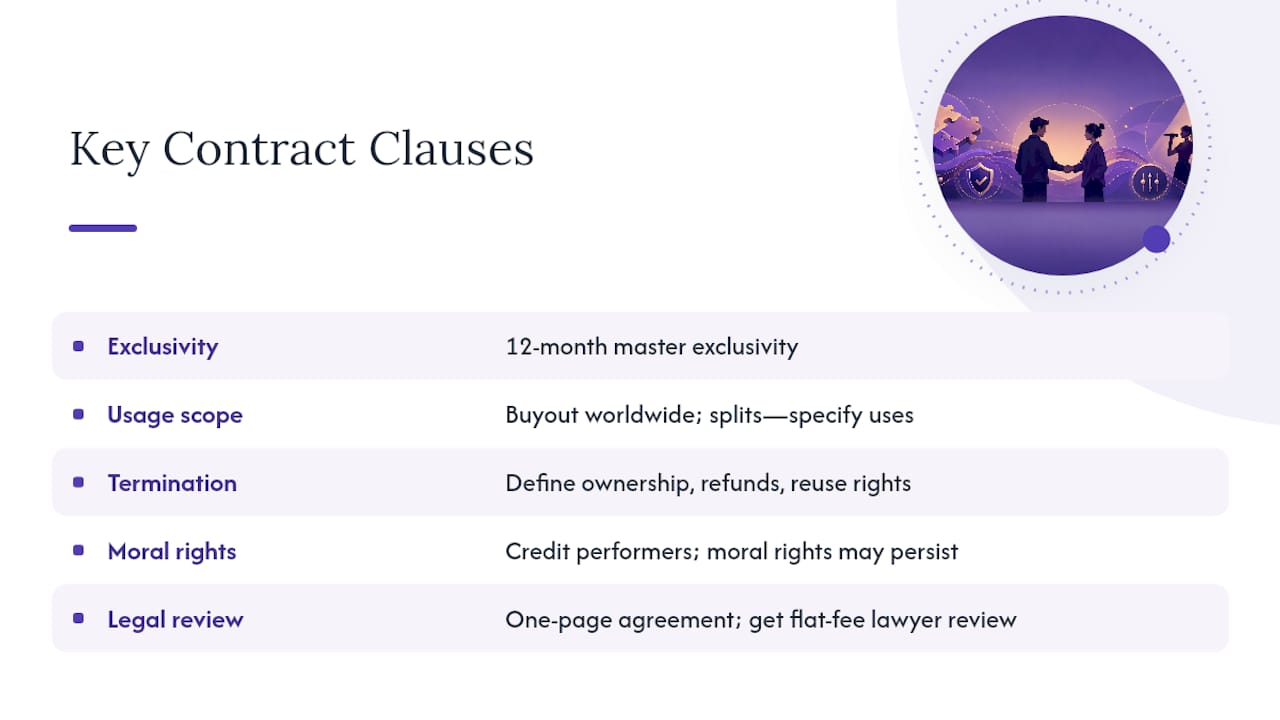
Exclusivity: Does the singer agree not to release their own version of the same vocal performance for a defined period? This matters most for commercial releases and sync licensing. A 12-month exclusivity window on the master recording is a reasonable starting point for most independent releases.
Usage rights scope: “Worldwide, perpetual, all platforms” is the standard for a full buyout. If you’re offering a split instead, specify which uses are covered: streaming, sync, live performance, remixes. A split that covers streaming but not sync can create problems if the track gets licensed later.
Termination clauses: What happens if the singer delivers unusable files, misses the deadline, or you decide to shelve the project? A simple termination clause should address: who owns the recorded material, whether any fee is refunded, and whether either party can use the session for other purposes. Without this, a shelved project can become a legal gray area.
Moral rights and attribution: In many jurisdictions, performers retain moral rights to attribution even after a full buyout. Credit the singer correctly on all distribution platforms from the start. Retroactively correcting metadata on streaming services is possible but slow and sometimes incomplete.
For any track with significant commercial potential, a one-page agreement reviewed by a music attorney is worth the cost. Most music lawyers offer flat-fee contract reviews, and the protection is disproportionate to the expense.
What actually matters when you hire a vocalist
The conventional wisdom in producer circles is to find the best voice available. That framing misses something. The best voice for a track is the one that fits the record’s emotional center, not the one with the most impressive range or the cleanest technique.
Producers who hire based on raw technical ability often end up with a vocal that sounds impressive in isolation and wrong in context. The singer who nails the audition task with a slightly imperfect take but unmistakable character will almost always serve the record better than the technically flawless vocalist who sounds generic.
The other thing most guides understate: communication quality predicts delivery quality more reliably than demo quality. A singer who asks the right questions, delivers the audition task on time, and sends files in the correct format is showing you their professional standard. A singer who sounds incredible but takes five days to reply to a simple message is showing you that too.
Run a paid test session. Not because you distrust the singer, but because it validates the entire chain: their recording setup, their interpretation of direction, their file management, and their turnaround time. One paid session is the most efficient vetting tool available, and it costs a fraction of the time lost to a failed full collaboration.
MyKasu connects you with the right singers, faster
Finding a singer across five different platforms, chasing replies, and comparing demos with no common format is a real time drain. MyKasu cuts that friction by putting producers and vocalists in the same focused space, where every profile includes audio, every post reaches music professionals, and every connection is relevant.
Create a free profile on MyKasu, post your project with your instrumental clip and brief, and use the search filters to shortlist vocalists by genre and role. Message your top candidates directly, run a paid test session with the best two or three, and collect deliverables in the format you specified. The whole workflow, from post to shortlist, can move in under 48 hours when your brief is clear and your clip is strong.
For independent producers who want targeted reach without the noise of general freelance platforms, MyKasu is the practical first stop.
Sources
- How to Find a Vocalist as a Producer (2026) | Tools 4 Music Blog | Tools 4 Music 2026
- How to Find Singers For Your Beats in 2025 (11 Best Sites)
- Top Vocal Talent: Singers & Vocalist Services | Fiverr