
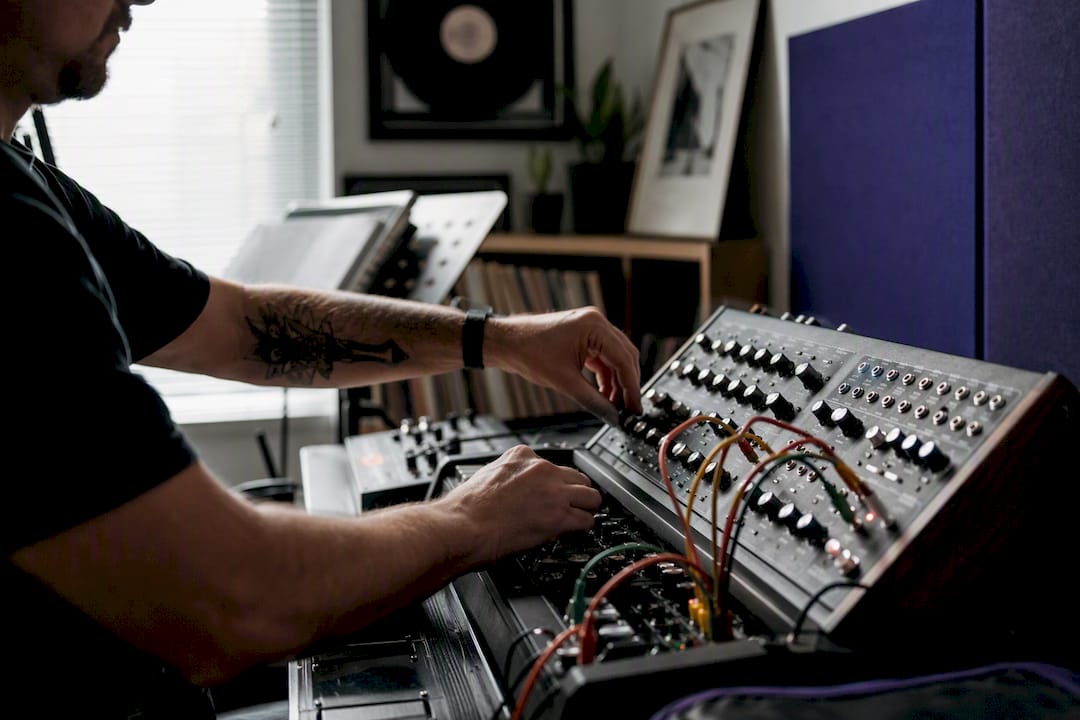
AI now works as a copilot in music, not a replacement for the people making it. It speeds up production, lowers the barrier to entry for new creators, and widens what’s possible in a home studio, but it hasn’t solved long-form composition or emotional depth the way a human songwriter can. Research from Carnegie Mellon backs this up, and institutions like Berklee are actively teaching musicians how to work alongside these tools rather than against them. The legal ground is still shifting too, and the U.S. Copyright Office has published guidance specifically because the old rules don’t cleanly apply.
Three things matter right now if you make music:
- Creatively, AI handles repetitive or formulaic tasks well but stalls on cohesive, emotionally layered work.
- Legally, authorship questions around AI-assisted tracks remain unsettled, and documentation of your own creative input matters more than ever.
- Industry-wide, platforms are starting to label AI content, and Spotify’s recent labeling policy shows just how messy that enforcement can get.
What to do next: experiment with AI tools cautiously, keep records of your own creative decisions (stems, session files, drafts), and check how any platform you release on defines and labels “AI-generated” content before you upload.
Key Takeaways
AI works best in music as a copilot that accelerates production and lowers entry barriers, while human judgment remains essential for long-form coherence, emotional depth, and legal authorship clarity.
| Point | Details |
|---|---|
| AI is a copilot, not a replacement | Use it for sketches, mastering, and stem work; keep creative judgment and structure human-driven. |
| Adoption is real but split | A significant share of surveyed musicians use AI in their work, while a notable portion avoid it entirely, per Berklee’s reporting. |
| Long-form creativity stays human territory | CMU research shows humans still lead on cohesion and emotional resonance. |
| Platform labeling is imperfect | Spotify’s AI-labeling policy risks flagging human work while missing genuinely AI-driven tracks. |
| Document your process | Keep stems, session files, and provenance notes to protect authorship claims. |
| MyKasu supports responsible adoption | The network helps musicians showcase provenance, find collaborators, and access gig opportunities built around transparent human contribution. |
This article is general information, not a substitute for advice from a qualified lawyer. Consult a qualified legal professional about your own circumstances before acting on anything here.
Table of Contents
- What Is AI Music? A Concise, Usable Taxonomy
- How Musicians Are Already Using AI in Their Work
- Which AI Music Tools and Research Projects Matter Right Now
- Where AI Falls Short and Why Human Musicians Still Matter
- How AI Is Reshaping Music Industry Workflows and Jobs
- Who Owns AI-Assisted Music? Copyright, Deepfakes, and Platform Policy
- How to Add AI to Your Creative Process Without Losing Your Voice
- Why a Music-Professional Network Matters for Responsible AI Use
- What’s Realistic to Expect From AI in Music Over the Next Few Years
- What AI Means for Live Shows and Audience Connection
- Can You Trust What You’re Hearing? The Authenticity Problem
- A Balanced Take on AI’s Place in Music
- How MyKasu Helps You Work With AI, Not Around It
- Sources
What Is AI Music? A Concise, Usable Taxonomy
“AI music” is not one thing. It’s a cluster of distinct technologies that get lumped together because they all involve machine learning, but they work in fundamentally different ways and serve different purposes.
Symbolic generation produces musical notation or MIDI data, the equivalent of sheet music, rather than actual sound. A model trained this way outputs notes, rhythms, and chord progressions that a human or synthesizer then has to render into audio. Audio generation, by contrast, works directly with waveforms, generating the actual sound you hear, textures, timbre, and all, without an intermediate notation step. This is the harder technical problem, and it’s where most of the recent hype lives.
Text-to-music systems take a written prompt, something like “moody synthwave with a driving bassline”, and generate an audio clip or musical sketch from it. Stem separation does the reverse kind of work: it isolates individual elements (vocals, drums, bass) from a finished mix, which is invaluable for remixing, sampling, or restoring old recordings where the original multitrack no longer exists. Real-time accompaniment tools listen to a live performer and generate a responsive backing part on the fly, useful for practice, live shows, or session work. Recommendation systems are the quietest but most pervasive form of AI in music: the algorithms deciding what shows up on your streaming feed.
A quick glossary, since these terms get thrown around loosely:
- Stem separation: isolating individual instrument or vocal tracks from a mixed audio file.
- Prompt engineering: crafting text input to get a specific, usable result from a generative model.
- Deepfake voice: synthetic audio designed to mimic a specific real person’s voice.
- Symbolic vs. audio generation: notation-based output versus direct sound-wave output.
AI systems work by predicting statistical relationships across audio tokens rather than genuinely understanding music, and prompt skill materially affects output quality, according to Google’s Magenta project. Stem separation, that same research notes, often reduces fidelity compared to the original master.
Symbolic tools tend to shine in composition and arrangement. Audio generation and text-to-music are strongest for pitching ideas quickly. Stem separation earns its keep in mixing, mastering, and remix work. Real-time accompaniment fits live performance. None of these categories is “the” AI music tool. They’re a toolbox, and knowing which drawer to open matters more than knowing the word “AI” at all.
How Musicians Are Already Using AI in Their Work
The theoretical stuff matters less than what’s actually happening in studios right now, and the honest answer is: a lot.
Co-writing and idea generation is probably the most common entry point. A songwriter stuck on a bridge can prompt a model for melody variations or chord alternatives, treating the output the way you’d treat a collaborator throwing out ideas in a writing session, most of which get discarded, a few of which spark something real. This isn’t fundamentally different from flipping through a chord book for inspiration, just faster and more varied.
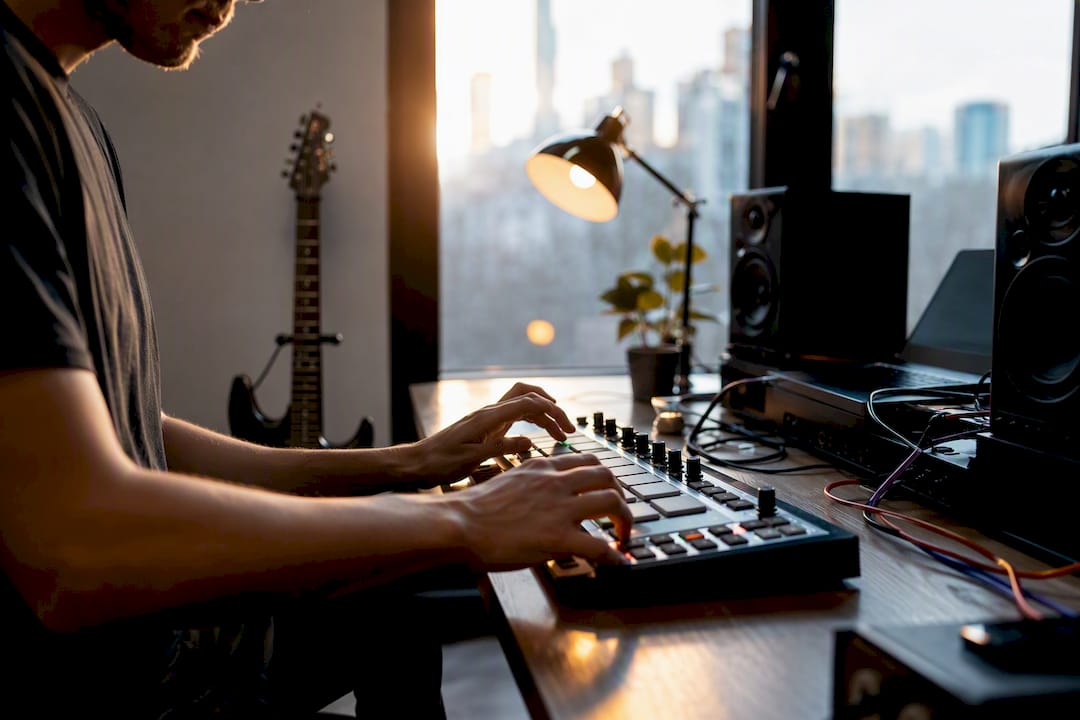
Arrangement and orchestration tools let composers generate quick demos of how a song might sound with a full string section or a different instrumental palette, without booking a single session musician. This is huge for pitching: a composer scoring for film or games can produce a text-to-music sketch to show a director “something like this” before committing budget to a real recording session.
Mixing and mastering automation has arguably seen the most mainstream commercial adoption. Services process a finished track and apply corrective EQ, compression, and loudness targeting automatically, cutting what used to be a multi-day back-and-forth with an engineer down to minutes. Stem separation plays a role here too, particularly for remixing older tracks where original multitracks were lost or restoring vocal isolation in poorly recorded live audio.
Voice cloning and deepfakes occupy the riskier end of the spectrum. Some artists use voice modeling legitimately, licensing their own voice for pitch demos or language dubbing. But the same technology has produced viral fake tracks featuring cloned voices of major artists without consent, a problem TIME’s coverage of AI in music documented as one of the industry’s most public flashpoints.
Recommendation engines are the AI most listeners interact with daily without realizing it, shaping what streaming platforms surface based on listening history, skip rates, and playlist behavior.
Adoption numbers back up how mainstream this has become. A Ditto survey cited by Berklee found that nearly 60% of surveyed musicians already use AI somewhere in their process, while 28% say they actively avoid it. That split tells you something important: this isn’t a fringe experiment anymore, but it’s also far from unanimous acceptance.
Which AI Music Tools and Research Projects Matter Right Now
Not every tool deserves your attention, but a handful of names keep coming up because they’ve genuinely shaped what’s possible.
- Google Magenta / MusicLM: Google’s research initiative into machine-learning music generation, with MusicLM specifically focused on producing audio from text descriptions. Best for exploring the cutting edge of text-to-music research rather than production-ready output.
- OpenAI MuseNet: a symbolic generation model trained to produce multi-instrument compositions across genres. Strong for creative experimentation and studying how far pattern-based composition can go; less useful as a plug-and-play production tool.
- AIVA: positioned specifically for composers needing orchestral or cinematic scoring, with a workflow built around customizable styles. Good for film, game, and media composers who need quick mood pieces.
- Riffusion: generates audio by treating sound as an image (spectrograms) run through diffusion models. Interesting for experimental texture work, less reliable for polished, release-ready tracks.
- LANDR: an automated mastering service widely used by independent musicians who don’t have budget for a mastering engineer on every release. Fast and consistent, though it can flatten the nuance a skilled human mastering engineer brings to a tricky mix.
- iZotope Ozone: mastering and mixing software with AI-assisted suggestions (loudness matching, EQ balancing) built into a professional plug-in suite. Best for producers who want AI assistance without giving up manual control.
- Spike AI: a stem separation and remix tool aimed at DJs and remixers who need clean isolated tracks from commercial releases. Useful, though separation quality still varies by source material.
- Apple Logic Pro (Session Players): built-in AI-driven virtual drummers, bassists, and keyboardists that respond to a project’s existing tracks. Best for solo producers who need a realistic-sounding rhythm section without hiring musicians.
When evaluating any of these, three questions matter more than marketing copy: What was the training data, and is that disclosed? What export formats does it support, and will your DAW handle them cleanly? And how does the stem or audio quality actually hold up against a professionally recorded source, not just a demo reel. A tool that can’t answer the training-data question honestly is one to treat with skepticism, especially given the unresolved copyright questions covered later in this piece.
Where AI Falls Short and Why Human Musicians Still Matter
Here’s the part the marketing decks tend to skip: current AI models are genuinely good at short, formulaic patterns and genuinely bad at sustained, emotionally coherent long-form work.
Research published in the Journal of the Society for American Music found that generative systems handle loops, short motifs, and genre pastiche convincingly but struggle to build the kind of structural and emotional arc that defines a great song or a great album. A verse-chorus-verse pop structure with a predictable hook is well within reach. A concept album that earns its emotional payoff over 45 minutes is a different problem entirely, one these models haven’t cracked.
CMU’s 2026 research reinforces this: even as AI-generated music has improved technically, human composers still lead on creative cohesion and the kind of emotional resonance that makes a piece of music endure past its first listen.
Why? Statistical models predict likely next notes or sounds based on patterns in training data. They don’t have lived experience, intent, or a reason for choosing one chord over another beyond probability. A human songwriter drawing on heartbreak, a specific memory, or a deliberate creative risk is doing something categorically different from a model optimizing for plausible continuation. Curation, the human judgment call of “this take, not that one,” “this dissonance stays,” remains something no model does on its own.
Practical takeaway: delegate the tedious and formulaic to AI. Let it generate quick sketches, handle repetitive production tasks, or suggest variations you’d never think to try. Keep the final creative judgment, the emotional throughline, and the structural decisions in human hands. That division of labor, not full automation, is where the real gains are.
How AI Is Reshaping Music Industry Workflows and Jobs
The production side of the music business is changing faster than the legal and economic frameworks around it, and that gap is where most of the real tension sits.
Workflow shifts are already visible. Prototyping a song idea used to mean booking studio time or at least a session with a co-writer. Now a producer can generate a rough arrangement overnight and bring a near-finished demo to a pitch meeting the next morning. Sync licensing, placing music in film, TV, or ads, has particularly benefited: composers can generate mood-matched sketches on demand instead of guessing what a music supervisor wants. Stem marketplaces, where producers buy and sell isolated tracks for remixing or sampling, have also grown as separation tools improved.
Jobs are shifting rather than simply disappearing. Roles tied to repetitive technical tasks, basic mixing cleanup, rough mastering passes, are under real pressure. But new roles are emerging alongside them: metadata managers who track provenance and rights on AI-assisted tracks, stem technicians who specialize in cleaning up AI-separated audio, and prompt-savvy producers who’ve essentially become AI wranglers within larger studio teams. Mix engineers handling complex, high-stakes projects aren’t going anywhere; the demand is shifting toward judgment-heavy work and away from routine passes.
Distribution economics are the most contentious piece. Streaming platforms pay out from a pooled royalty system, and if AI-generated tracks flood catalogs at a volume human artists can’t match, that pool gets diluted across far more streams. Billboard’s reporting on AI’s industry impact documents exactly this concern: labels and artists worried that low-effort AI content competing for the same royalty pool undercuts working musicians, even when that AI content generates minimal genuine listener engagement.
A rough timeline of how fast this has moved:
- 2023: viral AI-generated tracks using cloned artist voices trigger major-label takedown requests and public controversy.
- 2024 to 2025: mastering and stem-separation tools become mainstream in independent workflows; sync and pitch demos increasingly use text-to-music sketches.
- 2026: platforms begin experimenting with AI-content labeling policies, with Spotify’s approach becoming a focal point for both praise and criticism (more on that below).
The bigger picture: a16z frames this moment as generative AI’s “Midjourney moment” for music, a point where the barrier to entry drops sharply and the pool of people making music expands. That’s a genuine opportunity for new creators. It’s also exactly why distribution platforms and royalty systems are scrambling to catch up.
Who Owns AI-Assisted Music? Copyright, Deepfakes, and Platform Policy
This is the section every musician working with AI needs to actually read, because the legal ground here is unsettled and the consequences of getting it wrong, whether through mislabeling, disputed authorship, or a deepfake scandal, land squarely on creators.
Authorship and copyright hinge on a principle legal scholars keep returning to: technology neutrality, paired with recognition of human selection and arrangement. In plain terms, using a tool doesn’t disqualify you from authorship, the same way using a synthesizer instead of an orchestra never did. What matters is how much genuine human creative choice went into the final work. The Yale Law Journal’s analysis argues for exactly this framework: courts and copyright offices should look at what a human actually selected, arranged, and decided, not simply whether AI touched the process at all. The U.S. Copyright Office’s own guidance reflects this evolving standard, and it’s the primary resource to check before registering anything AI-assisted.
Deepfakes and voice cloning sit in genuinely murkier territory, both legally and ethically. A cloned voice singing lyrics an artist never recorded raises consent and right-of-publicity questions that vary significantly depending on jurisdiction. High-profile incidents, viral fake tracks using cloned voices of major artists, have already triggered takedown requests and public backlash, cases TIME documented as some of the clearest flashpoints in the whole AI-music debate. The lesson for working musicians: if you’re using voice modeling technology, get explicit licensing or use your own voice. Anything less is a legal and reputational risk not worth taking.
Platform policy is where this gets messiest in practice, and Spotify’s recent AI-labeling decision is the clearest example. Spotify has started flagging tracks it identifies as AI-generated, a reasonable-sounding move toward transparency for listeners. But detection isn’t precise. A track built with heavy AI-assisted mastering or a single AI-generated instrumental layer might get flagged as “AI music” even though a human wrote the song, performed it, and made every meaningful creative decision, essentially punishing legitimate human work for using a production tool. Meanwhile, a track that’s substantially AI-composed but was cleaned up or lightly re-recorded by a human might slip through unlabeled, defeating the transparency goal the policy was supposed to serve in the first place.
That mismatch, over-flagging some human work while under-flagging genuinely AI-driven tracks, is arguably the single biggest enforcement gap in the current wave of platform policy. It’s not a hypothetical: any detection system built on statistical pattern-matching will produce false positives and false negatives, and a musician’s income or reputation shouldn’t hinge on which side of that error rate they land.
Professional collaboration increasingly depends on transparency about human-in-the-loop steps, and artists who can clearly document their own creative contribution tend to earn more trust for professional work, according to a16z’s analysis of the industry. AI-only tracks, by contrast, are often treated as consumer-level output rather than professional work.
Practical steps worth taking now:
- Keep your original stems, DAW session files, and draft versions as proof of your creative process.
- Document specifically where and how you used AI tools in a project, not just that you used one.
- Register your work with the U.S. Copyright Office when eligible, and check current guidance before submitting anything AI-assisted.
- Monitor how any platform you release on defines “AI-generated” and watch for mislabeling of your own catalog.
- Keep an eye on international policy too; WIPO’s analysis of generative AI shows this is a global regulatory conversation, not just a U.S. one.
How to Add AI to Your Creative Process Without Losing Your Voice
If you want to actually use AI in your work rather than just read about it, here’s a workflow that keeps you, not the model, in charge of the final result.
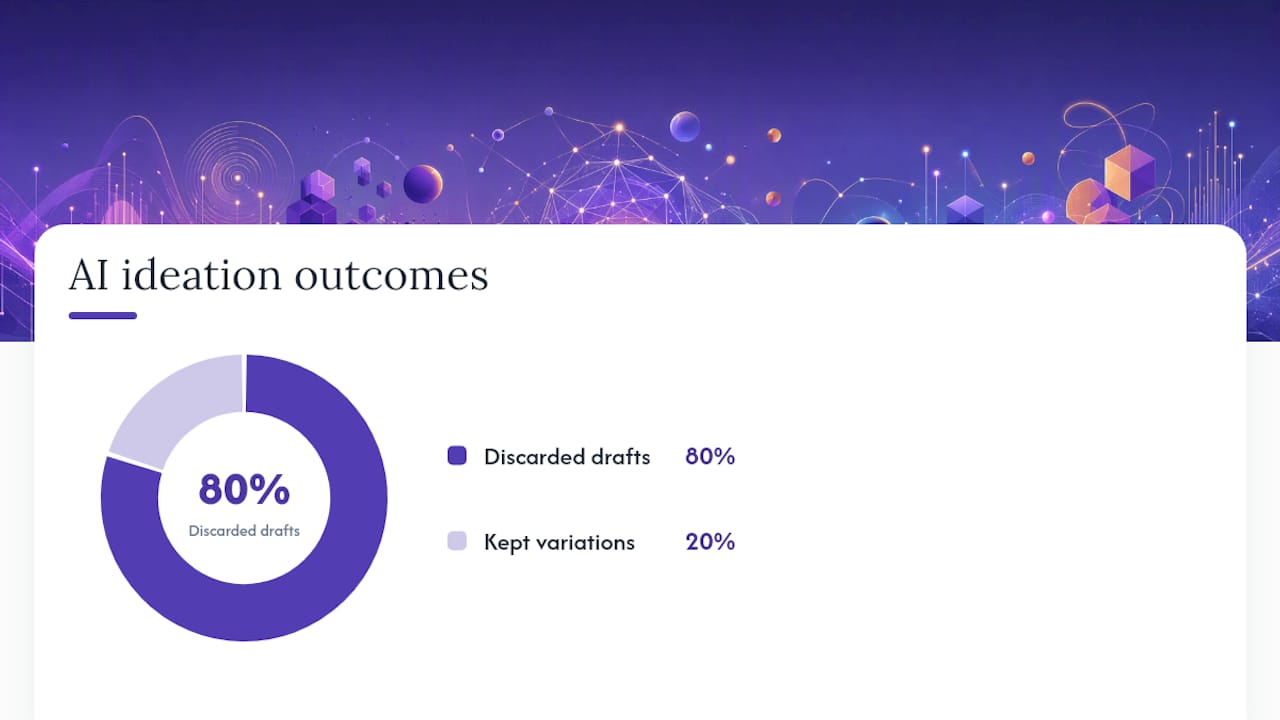
Step 1: Ideation with AI. Use a text-to-music or symbolic generation tool to sketch out rough ideas fast, chord progressions, melody variations, arrangement possibilities you wouldn’t have tried otherwise. Treat every output as a rough draft, not a finished thought. Generate ten variations and expect to throw away eight of them.
Step 2: Human edit and selection. This is the step people skip, and it’s the one that matters most. Go through what the AI generated and make deliberate choices: this melody fragment works, that chord change feels wrong, this rhythm needs to be looser. The selection process itself is a creative act, and it’s also the piece of your work that’s hardest to dispute later if anyone questions authorship.
Step 3: DAW refinement. Bring your selected ideas into your digital audio workstation and build them out properly, real performance, human timing, deliberate arrangement choices that reflect your taste rather than statistical averages. This is where a rough AI sketch becomes an actual song.
Step 4: Stem export. Once you’ve built the track, export clean stems, both for your own archive and in case you need to prove your process later, license the track for sync, or collaborate with someone else who needs isolated elements.
Step 5: Metadata and provenance recording. Document what you did and how. Note which sections started as AI-generated sketches, what you changed, and what was entirely your own writing or performance. This isn’t busywork. It’s the record that protects you if a platform mislabels your work or if a collaborator or publisher asks how the track was made.
Before you commit to any tool for this workflow, run it through a short checklist:
- Audio quality: does the output hold up against a professionally recorded reference, or does it sound obviously synthetic under scrutiny?
- Export options: can you get clean stems and standard file formats your DAW actually supports?
- Training-data transparency: does the company disclose what the model was trained on, or is that a black box?
- Licensing terms: who owns the output, and are you clear to use it commercially without restriction?
Pro Tip: Don’t just save your final mix. Save the messy middle: your rejected AI drafts, your edit notes, your session history. If anyone ever questions how much of a track is “really yours,” that paper trail is worth more than any argument you could make after the fact.
A quick real-world version of this: a solo producer prompts a text-to-music tool for a moody chord progression, picks the one variation that actually has the emotional weight the song needs, builds a full arrangement around it in their DAW with real vocal performance and hand-programmed drums, then exports stems and notes in their project file exactly which four bars started as an AI suggestion. That’s a human-driven song that happened to use AI as a starting point, not an AI song with a human afterthought.
Why a Music-Professional Network Matters for Responsible AI Use
Provenance, collaboration, and reputation are hard to manage alone, and this is exactly where a dedicated space for music professionals earns its keep. A general social platform wasn’t built to track who contributed what to a track or to connect you with collaborators who actually work in your genre and skill level.
Peer review and provenance tracking matter more now than they did five years ago, precisely because platform labeling systems like Spotify’s are imperfect. If your community and your professional profile already document your process, your stems, your session history, your collaboration credits, you have a stronger position if a platform or publisher ever questions how a track was made.
Community vetting helps too. A producer building a portfolio of AI-assisted work can share drafts with peers on a network like MyKasu before release, getting real feedback from other working musicians rather than guessing whether a mix or arrangement lands.
When evaluating any music-professional network, check for the fundamentals: real collaboration tools (not just messaging), rights and provenance metadata built into the profile structure, and an actual gig marketplace rather than a generic job board bolted on as an afterthought. Those three features are the difference between a platform that looks useful and one that’s genuinely built for the way musicians work.
What’s Realistic to Expect From AI in Music Over the Next Few Years
Set your expectations based on trajectory, not headlines.
Near-term (1 to 2 years): stem separation quality keeps improving, closing the fidelity gap that currently makes AI-separated tracks sound slightly worse than a real multitrack. Text-to-music tools get noticeably better at short-form output, think 30-second clips and loops, while long-form coherence remains a harder problem. Expect more platforms to experiment with AI-labeling policies, and expect those early systems to have rough edges similar to what Spotify is navigating now.
Medium-term (3 to 5 years): adaptive, dynamic music generation, the kind that responds in real time to a video game or VR environment, moves from research demo to genuinely usable product. Legal frameworks around AI authorship should get clearer as more court cases and copyright office rulings accumulate. Provenance and metadata standards, the technical backbone for proving what’s human-made versus AI-generated, likely mature into something closer to an industry norm rather than a patchwork of platform-specific policies.
Watch three signals closely: how copyright offices and courts rule on pending authorship cases, whether major-label litigation against AI companies settles or sets precedent, and what CMU and similar research institutions find as long-form AI composition keeps improving. Any of these could shift the landscape faster than the timeline above suggests.
What AI Means for Live Shows and Audience Connection
Live performance is the one place AI hasn’t fundamentally disrupted the core experience, and that’s telling in itself. Audiences show up to see a human being take real creative risks in real time, and that hasn’t changed.
Where AI has made inroads is in the tools around the performance rather than the performance itself. Real-time accompaniment systems can generate responsive backing parts for solo performers, effectively giving a single musician a full band’s worth of dynamic support without hiring additional players. Visual and lighting systems increasingly use AI to sync effects to a live audio feed in ways that used to require a dedicated technician calling cues manually. Some artists are experimenting with AI-driven interactive elements, visuals or backing elements that respond to crowd noise or movement, turning a passive audience into something closer to a participant.
The risk sits with authenticity expectations. If a fan later learns that a “live” vocal performance was heavily corrected or partially generated in real time, the backlash tends to be sharp, because live music’s entire value proposition is that it’s happening, unfiltered, in front of you. Artists using AI tools on stage would do well to be upfront about it rather than let audiences assume something was fully live when it wasn’t. Trust, once lost over a perceived live-performance deception, is hard to rebuild with the same audience.
Can You Trust What You’re Hearing? The Authenticity Problem
Quality control for AI-generated music runs into a problem traditional production never had to solve at scale: the same tool that produces a genuinely impressive result nine times can produce something subtly broken on the tenth, and it’s not always obvious which one you’re listening to.
Artifacts show up in specific, recognizable ways once you know to listen for them. Audio generation models sometimes produce phasing issues, odd frequency buildups, or transitions that feel slightly too smooth, missing the natural imperfection of a human performance. Stem separation tools frequently leave behind bleed or “ghosting” from other instruments that a trained ear catches immediately even when a casual listener wouldn’t. These aren’t dealbreakers for every use case, a quick pitch demo can tolerate more roughness than a commercial release, but they mean quality control can’t be automated away. Someone with real production experience still has to listen critically before a track ships.
The authenticity question runs deeper than technical polish, though. Listeners increasingly want to know whether what they’re hearing represents genuine creative intent or a statistically plausible imitation of it, and that distinction doesn’t show up in the waveform. Two tracks can be technically indistinguishable, one born from years of a songwriter’s lived experience, the other generated from a prompt, and no listening test tells you which is which. That’s precisely why documentation and provenance matter as much as audio quality. A label that accurately says “this is AI-assisted, here’s how” does more for authenticity than any technical fix ever could.
A Balanced Take on AI’s Place in Music
Generative AI in music genuinely splits opinion, and both sides are arguing from real evidence, not just fear or hype. The tool camp points to faster prototyping, lower barriers to entry, and genuinely useful production shortcuts. The threat camp points to diluted streaming royalties, unconsented voice cloning, and the real possibility that low-effort AI content crowds out the harder, slower work of human artists. Both things are true at once, and pretending otherwise does readers a disservice.
My honest read: the technology itself isn’t the danger. How platforms, labels, and individual artists choose to deploy it is where the real risk and the real opportunity both live. Spotify’s labeling stumbles aren’t a reason to abandon transparency efforts. They’re a reason to demand better ones, and to keep pressure on platforms to get detection right rather than shipping a flawed system and calling it done.
If you’re a musician deciding how to engage with any of this, experiment freely but document everything, and never let a tool make the creative decisions that are supposed to be yours. That’s not caution for its own sake. It’s how you protect the actual value of your work in a market that’s about to get a lot more crowded.
How MyKasu Helps You Work With AI, Not Around It
Every workflow this article recommends, documenting your process, tracking who contributed what, finding collaborators who share your standards, needs a home built for it. MyKasu is that home: a social network built specifically for music professionals, not a general platform trying to serve everyone at once. Musicians, producers, engineers, and promoters use it to showcase real work, connect with collaborators who understand provenance matters, and post or find paid gigs without competing for attention against unrelated content.
If you’ve read this far and want to start putting a human-in-the-loop workflow into practice, the first move is simple: create a MyKasu profile, upload a project with clear notes on your creative process, and start searching for collaborators or gig opportunities who value the same transparency you do.
Sources
- Music’s AI problem, AI’s music problem (Journal of the Society for American Music)
- Copyright
- AI and the Sound of Music | Yale Law Journal