
Your booking-ready bio is closer than you think. Below are three copy-paste examples you can personalize in under 20 minutes, followed by a micro-checklist to make each one yours.
One-liner (micro, ~25 words): Maya Reyes is a Chicago-based indie folk singer-songwriter whose layered acoustic storytelling has earned her stages at SXSW and Schubas Tavern.
Short bio (short, ~110 words): Maya Reyes writes songs that sit at the intersection of Appalachian folk and modern indie, built around fingerpicked guitar and close-harmony vocals. A Chicago native, she has performed at SXSW, Schubas Tavern, and the Old Town School of Folk Music, and her 2024 EP Hollow Ground reached the top 20 on Americana radio charts. Her live sets draw comparisons to Gillian Welch and Adrianne Lenker, though her sound is distinctly her own. Maya is currently booking dates for a fall Midwest tour and is available for festivals, listening rooms, and support slots. Contact: [email protected].
Long bio (~300 words): Maya Reyes grew up in Chicago’s Pilsen neighborhood, learning guitar from her grandmother and writing her first songs at fourteen. That early grounding in storytelling has shaped everything since: her music sits at the intersection of Appalachian folk and contemporary indie, built on fingerpicked acoustic guitar, close-harmony vocals, and lyrics that treat everyday Midwest life as worthy of a ballad.
She released her debut EP Hollow Ground in 2024, which reached the top 20 on Americana radio charts and earned her a feature in No Depression magazine. Live, she has performed at SXSW, Schubas Tavern, and the Old Town School of Folk Music, and she has shared stages with Watchhouse and Amythyst Kiah. Her sets are quiet but not small: audiences tend to go still.
Maya is currently writing her first full-length record, expected in late 2026, and is actively booking fall tour dates across the Midwest and Southeast. She is available for festivals, listening rooms, support slots, and college venues.
For booking and press inquiries: [email protected] | mayareyesmusic.com
Three quick edits before you paste:
- Swap the name, city, and genre for yours.
- Match the tense and person to the platform (third person for press; first person for personal pages).
- Update the contact line or CTA to reflect your current project or booking window.
Key Takeaways
A strong musician bio leads with the audience’s question, not the artist’s resume, and every version from the one-liner to the long-form EPK bio should end with a clear way to reach you.
| Point | Details |
|---|---|
| Match length to platform | Use 20–30 words for social headers, 75–150 for streaming/booking, and 250–400 for EPKs and press kits. |
| Third person for press | Use third-person voice for any bio a journalist or booker might copy directly into materials. |
| Lead with the hook | Open with the audience experience or a defining sound quality, not your name or hometown. |
| Maintain a master bio | Keep a 250–400 word master file and derive shorter versions from it rather than rewriting each time. |
| Mykasu for hosting | Publish your finished bio on Mykasu to place it alongside audio, gig listings, and industry connections. |
Table of Contents
- What do musician bio examples actually need to cover?
- How long should your bio actually be?
- Third person, first person, and how to format each
- What every bio needs to include
- Ready-to-use bio examples across roles and genres
- Common mistakes and how to fix them
- Fill-in-the-blank templates you can paste right now
- How to adapt your bio for each platform
- How to revise and fact-check your bio before publishing
- The bio that actually gets you booked
- Where to host and showcase your finished bio
- Sources
What do musician bio examples actually need to cover?
The audience reading your bio determines almost everything: what you lead with, how long you run, and which details earn their place on the page. Get this wrong and a perfectly written bio lands flat because it answers the wrong person’s questions.
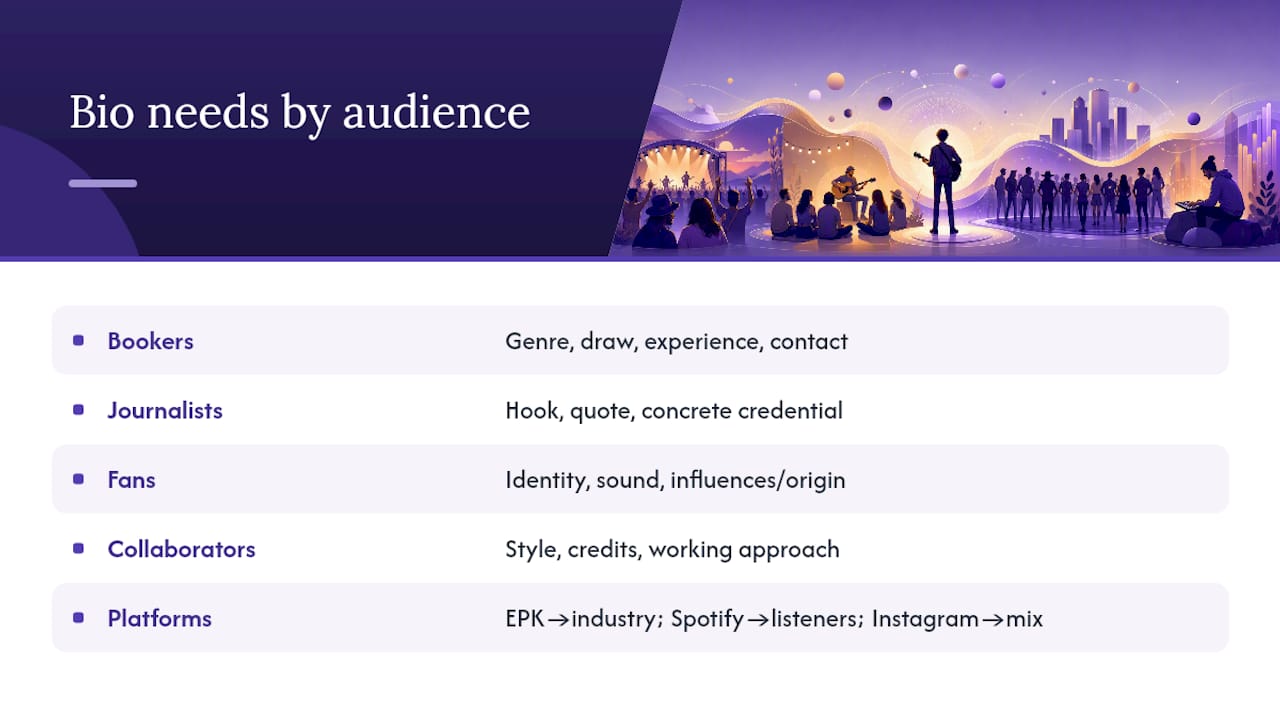
Bookers and talent buyers want fit and professionalism above everything else. They need to know your genre, your draw, your experience level, and how to reach you. They are not reading for inspiration.
Journalists and music editors want a story. They are looking for a hook they can lift directly into a preview or feature, a quote they can use, and at least one concrete credential that justifies covering you. Vague language kills press pickup.
Fans connect through identity and emotion. They want to know who you are, what you sound like, and why your music exists. A short, honest paragraph about your influences or your origin story does more work here than a list of venues.
Collaborators and producers are scanning for style, credits, and working approach. They want to know what you make and whether your aesthetic overlaps with theirs.
Platform often signals audience. An EPK goes to industry; a Spotify bio goes to listeners; an Instagram bio goes to a mix of both, skewed toward fans. When in doubt, ask: who is most likely to read this specific page and what do they need to decide next?
Pro Tip: Write the audience’s question at the top of a blank page before you draft. “Would this artist fit our festival?” or “Is this worth a feature?” forces you to answer the right thing instead of listing your own highlights.
How long should your bio actually be?
Length is not about thoroughness. It is about where the bio lives and who reads it there. Keeping a 250–400 word master bio and deriving shorter versions from it saves time and keeps your messaging consistent across platforms.
| Length | Word target | Primary use |
|---|---|---|
| Micro (one-liner) | 20–30 words | Social profile header, streaming tagline, email signature |
| Short | 75–150 words | Instagram bio, Spotify artist bio, booking inquiry email |
| Medium | 150–250 words | Facebook About, website sidebar, festival submission |
| Long | 250–400 words | EPK, full website bio, press kit, grant application |
A few practical notes on each:
- Micro: One sentence. Name, genre, one credential. No fluff.
- Short: Two to three tight paragraphs. Hook, one or two achievements, contact or CTA.
- Medium: Adds a little origin story or influence context. Still ends with current activity and contact.
- Long: Full narrative arc. Background, achievements, current project, booking info. This is your master version.
The mistake most artists make is writing one long bio and pasting it everywhere. A 350-word bio on an Instagram profile reads as a wall of text. A 25-word bio in an EPK leaves a booker with no context. Match the length to the container.
Third person, first person, and how to format each
The rule is simple: use third person for any bio that someone else might read aloud, copy into a program, or paste into a press release. That covers EPKs, press kits, booking pages, and most website bios. The San Francisco Conservatory of Music’s professional development guide recommends third-person bios for press and EPK use precisely because a journalist or promoter can drop them into materials without rewriting a single pronoun.
First person works on personal About pages, artist statements, and anywhere the voice is clearly yours speaking directly to a fan or collaborator. It feels warmer and more direct in those contexts.
Formatting rules that matter:
- Bold your name on first mention in longer bios so it reads as a proper entry point.
- Keep paragraphs to three to five sentences. A wall of text loses a booker in the first scroll.
- Place contact info and links at the end of the bio, not the top. Lead with the story; close with the ask.
- If you include a media quote, attribute it fully: publication name, writer if known, and year.
- Avoid bullet points inside a bio. Prose reads as narrative; bullets read as a resume.
Dos and don’ts:
- Do write in a consistent tense (present for current activity, past for achievements).
- Do name specific venues, publications, and collaborators. Specificity builds credibility.
- Don’t open with “I was born in…” or “My name is…” Both are wasted first sentences.
- Don’t use superlatives you cannot back up (“one of the most exciting artists of her generation”).
Pro Tip: Keep a third-person and a first-person version of your short bio saved separately. When a festival or journalist asks for a bio, you can paste the right one immediately without rewriting under deadline pressure.
What every bio needs to include
Bandzoogle’s bio guide outlines a structure that holds up across genres and career stages: introduce name and style, add background, list achievements, close with current activity. Here is that structure as a working checklist:
- Hook: One sentence that captures your sound, your vibe, or the audience experience. Not your name. Not your hometown. The thing that makes someone want to keep reading.
- Role and genre: Name, instrument or role, genre, and any key influences or comparisons that help a stranger place you quickly.
- Key achievements: Two or three specific, verifiable highlights. Think: notable venues, chart positions, press features, awards, or high-profile collaborators. For bookers, a credential means something they can check. For fans, it means something they recognize.
- Recent or current work: Your latest release, an upcoming tour, or a current project. This signals that you are active and worth paying attention to now.
- CTA or contact: Booking email, website link, or a direct invitation to reach out. Make it easy to take the next step.
What counts as a useful achievement depends on who is reading. A booker cares that you played Bonnaroo or headlined a 500-cap room. A fan cares that you toured with an artist they love or that a song of yours went viral on TikTok. Name the credential in terms the reader already values.
Ready-to-use bio examples across roles and genres
These samples cover common artist types. Each is written in third person for press and booking use. Adapt the name, genre, and details to fit your own profile.
Solo singer-songwriter (short)
Indie band (medium, ~200 words)
The Hollow Pines are a four-piece indie rock band from Portland, Oregon, known for their blend of post-punk energy and Pacific Northwest atmosphere. Formed in 2021, the band built their following through relentless regional touring and a string of self-released singles that collectively earned over two million streams on Spotify.
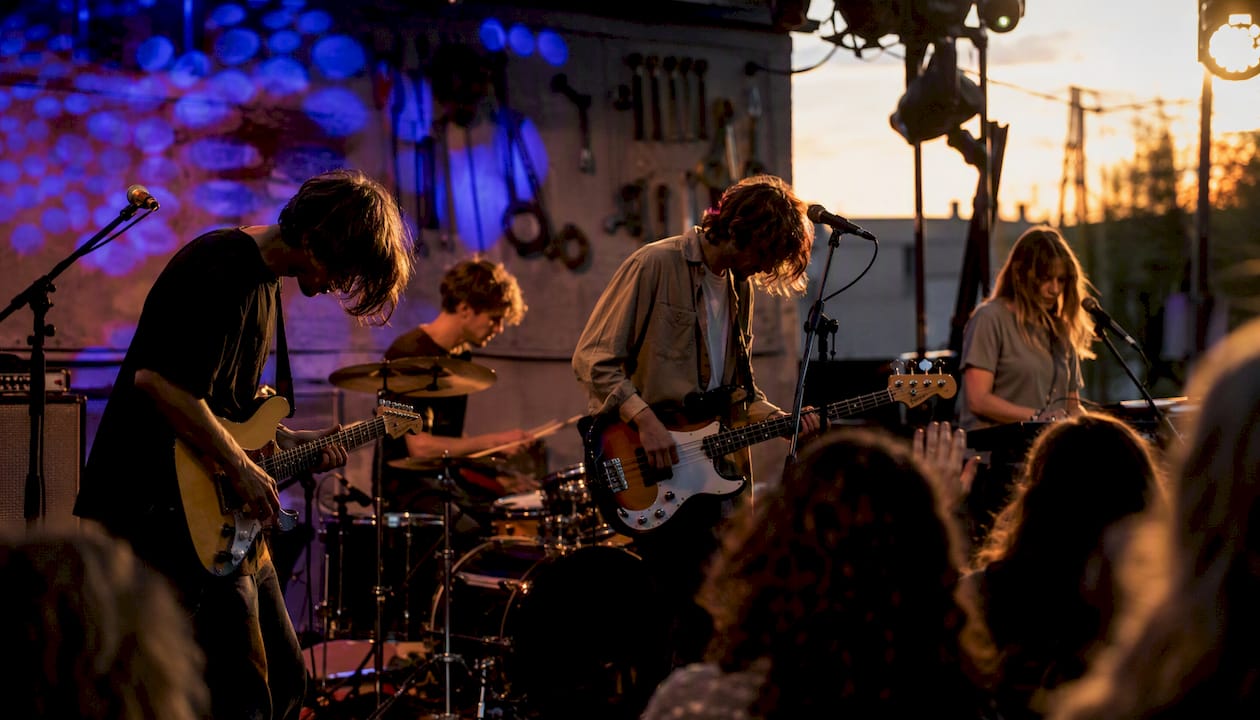
Their 2024 debut album Fog Season received coverage in Consequence and The Oregonian and landed them support slots with Wet Leg and Alvvays. Live, they are loud, precise, and occasionally funny. The Hollow Pines are currently writing their second record and booking festival and headline dates for summer 2026. Booking inquiries: [email protected].
Electronic producer (short)
SOLVÉ is a Los Angeles-based electronic producer and DJ whose sets move between ambient techno and deep house, shaped by a background in classical piano. He has released on Ghostly International and performed at Movement Detroit and Moogfest. His 2025 EP Drift States has been featured in DJ Mag and Resident Advisor. For bookings and licensing: solvemusic.com.
Before/after rewrite
Here is a common first draft and a revised version that fixes the most frequent problem: writing for yourself instead of the reader. Dan Ruch recommends starting with the audience experience rather than a self-focused list of accomplishments.
Before: “I have been playing guitar since I was eight years old and have always loved music. I have performed at many local venues and released three albums. I work hard on my craft and hope to connect with more fans.”
After: “Cara Solis plays fingerstyle guitar with the patience of someone who has been doing it since childhood and the precision of someone who never stopped. Based in Austin, she has released three albums and performed across Texas and the Southwest. Her latest record, Slow River, is out now on all platforms.”
What changed: removed the self-focus (“I have always loved music”), replaced vague claims (“many local venues”) with a geographic scope, and ended with a current release instead of a hope.
Common mistakes and how to fix them
Most bio problems fall into a handful of predictable patterns. Here is what to look for and the exact edit to make:
- Writing for yourself, not the reader. The fix: replace “I love making music” with a sentence that describes what the listener experiences. “Her sets feel like a late-night conversation” does more work than “I am passionate about connecting with audiences.”
- Opening with your name and hometown. The fix: move name and location to the second sentence. Open with the hook. “Chicago’s Maya Reyes” is a fine second line; it is a weak first one.
- Listing every gig you have ever played. The fix: keep only the three to five most recognizable or recent venues. Group smaller regional dates under a summary phrase. Remove any gig listing older than three to five years unless it is a signature appearance like a major festival or landmark venue.
- No contact information. The fix: add a booking email or website link at the end of every bio version. A booker who cannot find your contact after reading your bio will not search for it.
- Superlatives with no proof. The fix: replace “one of the most exciting artists in the scene” with a specific quote, chart position, or venue name. Specifics are credible; superlatives are not.
- Outdated information. The fix: treat your bio as a living document. After every major release or tour, update the current-project line and remove anything that dates the text.
Fill-in-the-blank templates you can paste right now
These templates use labeled placeholders. Fill each bracket with your own details and the bio is done. TemplateHall offers downloadable versions in Word, Google Docs, and PDF if you prefer a formatted file.
One-liner template: [Artist Name] is a [city]-based [genre] [role] known for [one defining quality or sound], with performances at [notable venue or event] and [second venue or event].
Short bio template (75–150 words): [Artist Name] makes [genre] music rooted in [key influence or sound quality]. Based in [city], [he/she/they] [has/have] released [number] [albums/EPs/singles] and performed at [notable venue], [second venue], and [third venue or event]. [His/Her/Their] [most recent release] received [press mention or chart result]. [Artist Name] is currently [touring/recording/booking] and is available for [festival/headline/support] dates. Contact: [email or website].
Long bio template (250–400 words): [Artist Name] grew up in [city or region], [brief origin detail that connects to the music]. That background shapes [his/her/their] sound: [genre], built on [key sonic elements], and informed by [influences or comparisons].
[He/She/They] released [debut or most recent project] in [year], which [chart result, press mention, or notable outcome]. Live, [Artist Name] has performed at [venue 1], [venue 2], and [venue 3], and has shared stages with [notable artist or artists]. [One sentence describing the live experience or what makes the performance distinctive.]
[Artist Name] is currently [working on / touring in support of] [current project], expected [timeframe]. [He/She/They] [is/are] actively booking [type of dates] for [season or year].
For booking and press: [email] | [website]
Completed sample (short template filled in): Dara Osei makes West African-influenced R&B rooted in highlife guitar and contemporary soul production. Based in Atlanta, she has released two EPs and performed at A3C Festival, Terminal West, and the Afropunk Atlanta stage. Her 2025 single “Gold Cloth” received a feature in Okayplayer. Dara is currently booking spring and summer dates and is available for festival, headline, and support slots. Contact: daraosei.com.
Pro Tip: When you swap in your own details, prioritize your most recent release over an older one, even if the older project got more press. Bookers and journalists want to know what you are doing now.
How to adapt your bio for each platform
The same core bio needs a different shape depending on where it lives. Here is how to adjust for the most common platforms:
- Spotify/Apple Music: 150–250 words, written for listeners. Open with a sound description or mood reference, not a venue list. Include a link to your latest single in the first paragraph if the platform allows it. Streaming bios benefit from a listener-focused opening line that references sound or mood.
- Instagram: 150 characters maximum. Name, genre, one credential, link. Every word counts. Example: “Indie folk | Chicago | SXSW alum | New EP out now 👇”
- Facebook About: 200–300 words. Slightly more relaxed than an EPK bio. Can include a short origin story and a direct link to your booking page.
- Website (full bio page): 250–400 words, third person. This is your master bio. Include a press photo, a media quote if you have one, and a clear contact section.
- EPK/press kit: Same as website bio but formatted for easy copy-paste. Bold your name on first mention. Include a one-paragraph short version at the top for editors who need a quick pull quote.
SEO note: Place your artist name and primary genre in the first sentence of any public-facing bio. Search engines index the opening lines of profile pages most heavily, so “Maya Reyes is a Chicago indie folk artist” in the first sentence does more for discoverability than burying it in paragraph three. Use your genre and city as natural keywords throughout, not just once.
A platform’s character limit often signals its audience. Instagram’s 150-character cap tells you the reader is a fan scrolling fast. An EPK with no word limit tells you a journalist or booker is reading carefully. Match your depth to that signal.
How to revise and fact-check your bio before publishing
A finished draft is not a finished bio. Run it through this checklist before you post anywhere:
- Third-person check: If this bio will go to press or a booker, confirm every pronoun is third person. No “I” or “my.”
- Claim verification: Every venue, chart position, press mention, and collaborator named in the bio should be something you can prove. The Mid-America Arts Alliance notes that bios are narrative introductions, not CVs, but every claim still needs to be accurate. A journalist who fact-checks and finds an error will not run the piece.
- Quote attribution: If you include a media quote, confirm the publication name, the writer’s name if available, and the year. “Stunning” — Rolling Stone is not a full attribution. “A stunning debut” — Rolling Stone, 2024 is.
- Links and contact: Click every link in the bio. Confirm your booking email is current. A dead link in an EPK is a missed booking.
- Date the file: Save your master bio with a version date in the filename (e.g., MayaReyesBio_March2026.docx). Treating your bio as a living document with version control keeps you from accidentally sending an outdated file.
- Read it aloud: If a sentence makes you stumble, a journalist will too. Rewrite it.
“Write for the reader, not for yourself. Ask: what does this person need to know to decide whether to book me, cover me, or listen to me? Answer that question and stop.” — paraphrased from Dan Ruch’s musician bio guide
Peer editing questions to ask a trusted colleague:
- Does the opening sentence make you want to keep reading?
- Can you tell what genre this artist plays after the first two sentences?
- Is there anything here you would cut?
- Is there anything missing you would want to know as a booker or fan?
The bio that actually gets you booked
Most musicians spend too long on the long bio and too little time on the one-liner. The micro version is the one that travels. It goes in email signatures, social headers, and the first line of a cold booking pitch. If that sentence is weak, nothing else matters.
The second thing writers consistently underestimate is the contact line. A bio without a clear next step is a dead end. Every version, even the 25-word one, should end with a way to reach you.
Write the long version first, then cut it down. You will find the hook buried in paragraph two almost every time. Pull it to the top, cut the rest to fit the platform, and you have a short bio that works. Maintaining a master bio of 250–400 words and deriving shorter versions from it is the most practical system for staying consistent across platforms without rewriting from scratch every time.
After a release or a significant tour, update the current-project line and the recent achievements. The rest of the bio can stay stable for a year or more. Treat it as a document with a version date, not a static page you set and forget.
Where to host and showcase your finished bio
Once your bio is written, it needs a home that works as hard as the text does. A music-specific platform gives you more than a profile page: it puts your bio next to your audio, your gig listings, and your contact information in one place that industry professionals actually use.
Mykasu is built specifically for music professionals, which means your bio sits alongside your audio projects, press materials, and gig opportunities rather than competing with lifestyle content or general networking noise. You can publish your master bio, link your latest releases, and post or browse paid gig opportunities, all within a community of musicians, producers, engineers, and promoters who are there for the same reasons you are. It is the difference between a profile that exists and one that actively connects you to the next collaboration or booking.
Publish your finished bio on Mykasu, link your master file, and start connecting with the collaborators and opportunities your bio is now ready to attract. Join Mykasu here.
Sources
A short list of the sources used in this article, each worth bookmarking for ongoing reference:
- How to Write a Killer Musician Bio (With Examples)
- Musician Bio Template for Press Kits and Booking
- How to write an effective musician bio (with examples!)
- How to Write an Artist Bio with Tips and Examples
- Music bio guide (SFCM professional development handout)