
Both, but not equally, and not right away. If you’re picking one thing to do this week, build an email list. Send fans from Instagram or TikTok to a single landing page with a sign-up form, because email marketing regularly delivers some of the highest ROI of any owned channel, while a full custom site can wait until you know what it needs to sell.
Key Takeaways
Independent musicians get the best results by using social platforms for discovery and a website plus email list for ownership, retention, and revenue.
| Point | Details |
|---|---|
| Start with email, not a full site | Send social traffic to a simple landing page with an email sign-up this week. |
| Build a site once you have a reason | Bookings, press requests, or merch sales justify the time investment. |
| Match platforms to goals | Use TikTok for discovery, YouTube for long-form video, Instagram for visual branding. |
| Own what you can | Email and Bandcamp protect you from algorithm shifts and platform shutdowns. |
| Network where music professionals gather | MyKasu connects you with collaborators and gig opportunities outside the general social feed. |
Table of Contents
- Musician Website vs Social: The Quick Trade-Off Breakdown
- When Do You Actually Need a Website?
- When Is Social Media Enough on Its Own?
- How to Turn Social Followers into Website Visitors
- What Belongs on a Musician’s First Website
- Which Social Platform Fits Which Goal?
- What Does It Cost to Launch and Maintain a Site?
- Why Owning Your Audience Actually Pays Off
- Balancing Time Between Social and a Site
- How MyKasu Fits Into Your Social-to-Site Funnel
- Frequently Asked Questions
- Sources
Musician Website vs Social: The Quick Trade-Off Breakdown
Each channel wins on different things, and confusing them wastes effort.
- Control and ownership: A website is yours. Social accounts operate under someone else’s rules, and platforms like Vine and the original MySpace have vanished, taking artists’ audiences with them.
- Discoverability and reach: Social wins here, full stop. Short-form video and platform-native content get you in front of strangers; a website almost never does that on its own.
- Fan retention: A website with email capture keeps working for years. A post disappears from feeds within a day or two.
- Monetization: Bandcamp and a website store put money directly in your pocket. Social platforms mostly monetize your attention, not your bank account.
- Analytics: Your site’s data belongs to you permanently. Instagram’s insights vanish the moment the platform changes its dashboard or your account gets flagged.
Pro Tip: Think of social as the megaphone and your website as the house. A megaphone reaches more people. A house is where they actually stay.
When Do You Actually Need a Website?
Skip the website until you have a real reason for one, then build it before you need it, not after.
- Booking gigs: Promoters and venue bookers want a professional EPK with music, photos, and a stage plot in one place, not scattered across four apps.
- Landing press: Journalists Google you before they write about you. A blank Instagram grid doesn’t answer the questions they have.
- Selling merch or downloads: A store page you control keeps a bigger cut than most third-party marketplaces.
- Owning your audience: Email addresses don’t disappear when an algorithm changes.
If you’re still writing your first songs, wait. If you’ve got a show booked, a release coming, or a journalist asking for a bio, build the site this month.
When Is Social Media Enough on Its Own?
Early on, chasing discovery matters more than owning infrastructure nobody’s visiting yet.
- You’re testing songs and sounds and need fast feedback, not a portfolio.
- Bookings, collabs, or sync inquiries are already landing in your DMs without a site.
- You post consistently and see steady follower or stream growth month over month.
Social-only gets risky fast once a booker asks for a press kit you don’t have, or your account gets suspended and takes your entire following with it. That’s the moment a simple site stops being optional.
How to Turn Social Followers into Website Visitors
Here’s a funnel you can build in a weekend and run for years.
- Attract on social. Post short-form video, behind-the-scenes clips, or live snippets where discovery already happens, per Berklee’s marketing research.
- Send them to one landing page. Your bio link should point to a page built for one action, not your homepage. 12AM Agency’s design guide calls this the difference between a link that converts and one that just sits there.
- Capture the email. Offer a free download, early ticket access, or a demo in exchange for an address.
- Convert with something specific. A merch drop, a ticket link, or an EPK sent straight to a booker.
Picture it as a funnel: wide at the top (social reach), narrowing at the middle (the landing page), narrowing again at capture (email list), and opening back up at the bottom into real revenue.
Pro Tip: Time your landing-page push around a release or show, not a random Tuesday. Traffic converts better when there’s a reason to act now.
Pro Tip: Match the content format to the platform, then funnel everything to the same landing page so you’re not fragmenting your audience across five different links.
What Belongs on a Musician’s First Website
Keep it to the pages that actually do a job.
- Home: One clear line about who you are and what you sound like.
- Music: Embedded streams from Spotify, Apple Music, or Bandcamp.
- Tour/shows: Even if it’s one date, keep it current.
- EPK/press: Bio, photos, and any past coverage.
- Contact/booking: A form, not just an email address buried in a bio.
- Store: Merch, downloads, or a link to Bandcamp.
- Email sign-up: The single most important box on the page.
Include obvious calls to action: “Listen Now,” “Join the List,” “Book This Artist.” Berklee Online points to usability and clarity of purpose as the two things that separate a site that converts from one that just exists. Keep the URL short, make it mobile-first, and don’t let load time creep past a few seconds. A core set of five features, music, EPK, booking contact, tour dates, and email capture, covers most of what an early-career artist needs.
Which Social Platform Fits Which Goal?
Different platforms reward different behavior, so match the platform to what you’re actually trying to accomplish.
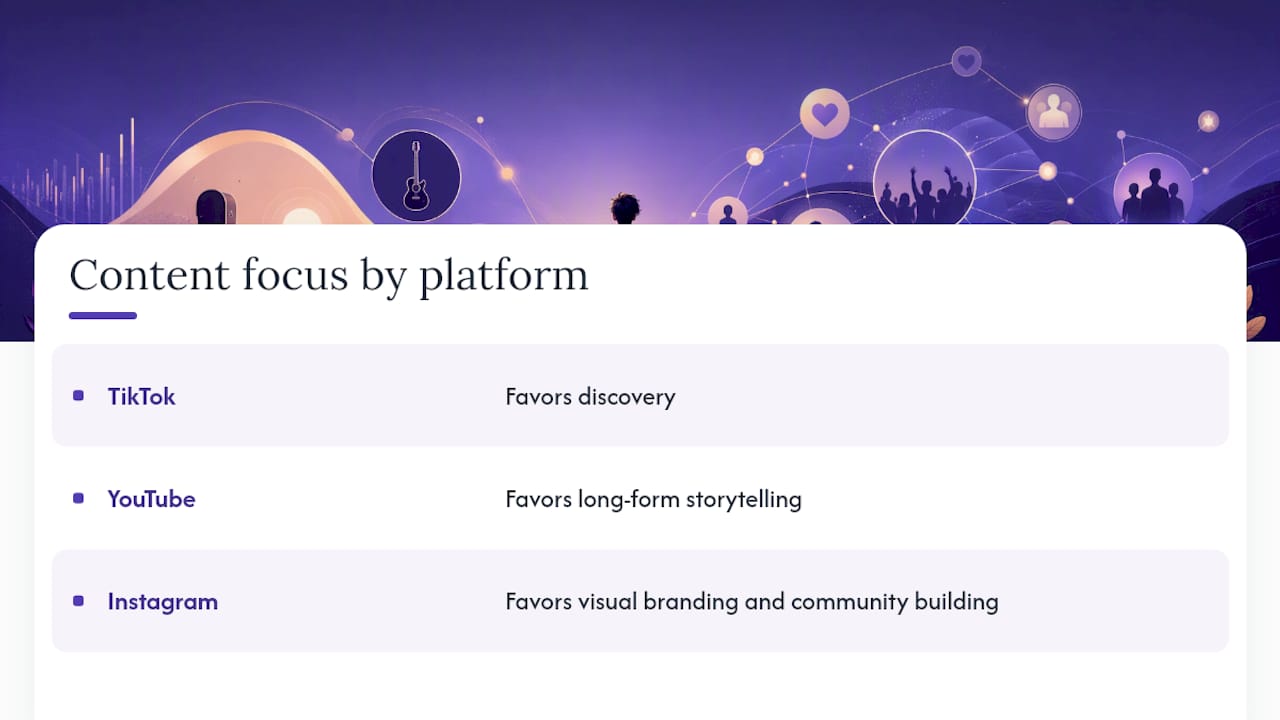
- TikTok: Discovery and virality. Post short clips several times a week and lean into trends without losing your sound.
- YouTube: Long-form storytelling. Music videos, behind-the-scenes documentaries, live sessions.
- Instagram: Visual branding and community. Stories for daily connection, feed posts for polish.
- Spotify and Apple Music: Not community platforms, but critical for streaming discovery through playlists and algorithmic recommendations.
Cross-post the same core content everywhere, but reformat it for each platform’s native style rather than dumping identical files across all four.
What Does It Cost to Launch and Maintain a Site?
Pick the tier that matches your time and budget, not the one that looks most impressive.
- DIY low-cost: Template builders like Bandzoogle or Squarespace, a few hours to launch, minimal ongoing cost. 12AM Agency notes Bandzoogle leans music-specific while Squarespace leans design-forward.
- Template builder with more control: A weekend build, moderate cost, more customization than DIY kits.
- Custom WordPress or agency build: Days to weeks, higher cost, full control and scalability.
Update your site whenever you have new music, shows, or press. A quarterly ten-minute check is enough to keep it current.
Why Owning Your Audience Actually Pays Off
Social platforms are built to limit how many of your own followers see your posts unless you pay to boost them. Instagram’s organic reach averages around 3.5% per post, and Facebook’s sits closer to 1.2%, meaning most of your audience never even sees what you share for free.
- Bandcamp lets fans buy directly, with money going straight to the artist rather than diluted through ad-driven feeds.
- Email lists don’t decay the way organic reach does; an address collected two years ago still works today.
If retention and revenue matter more to you than raw visibility, prioritize the channels you own.
Balancing Time Between Social and a Site
Hire help or use a template builder the moment site maintenance starts eating into time you’d rather spend writing songs. My own rule: build the site before you think you need it, not after a booker asks for one you don’t have.
How MyKasu Fits Into Your Social-to-Site Funnel
Social builds your audience. A website converts them. MyKasu fills the gap in between: a music-first social network where musicians, producers, engineers, and promoters showcase real work and find paid gigs, without competing against food photos and dance trends for attention. Where Instagram scatters your presence across a general feed, MyKasu keeps you inside a professional music community actively looking for collaborators and opportunities. It slots naturally into your funnel as a discovery and networking layer, sitting alongside your personal website rather than replacing it, feeding warmer leads toward your EPK, your booking page, and your email list. If you’re tired of shouting into a general algorithm, check out MyKasu and see who’s already looking for someone like you.
Frequently Asked Questions
Do musicians really need a website in 2026, or is social media enough? Most independent musicians benefit from having both. Social handles discovery, but a website gives you a stable, owned presence that protects against platform outages and algorithm changes.
What’s the single most important thing to put on a musician website? An email sign-up form. It’s the one feature that keeps working for you long after a social post disappears from feeds.
Which social platform should I focus on first? It depends on your goal. TikTok favors discovery, YouTube favors long-form storytelling, and Instagram favors visual branding and community building.
How much does it cost to build a basic musician website? DIY builders can get you online for very little money in a few hours. Custom builds cost more and take longer but offer greater control.
Can I skip a website if bookings are already coming through social media? You can delay it, but the moment a booker or journalist asks for a proper EPK, you’ll want a site ready to go rather than scrambling to build one.
Sources
- Music marketing: 5 practical strategies for independent artists — Berklee (Berklee Now)
- Why musicians need their own website — Discovery Music Group
- How to create a website as a musician — Berklee Online
- How to design a music website: A 9-step guide for artists in 2025 — 12AM Agency