
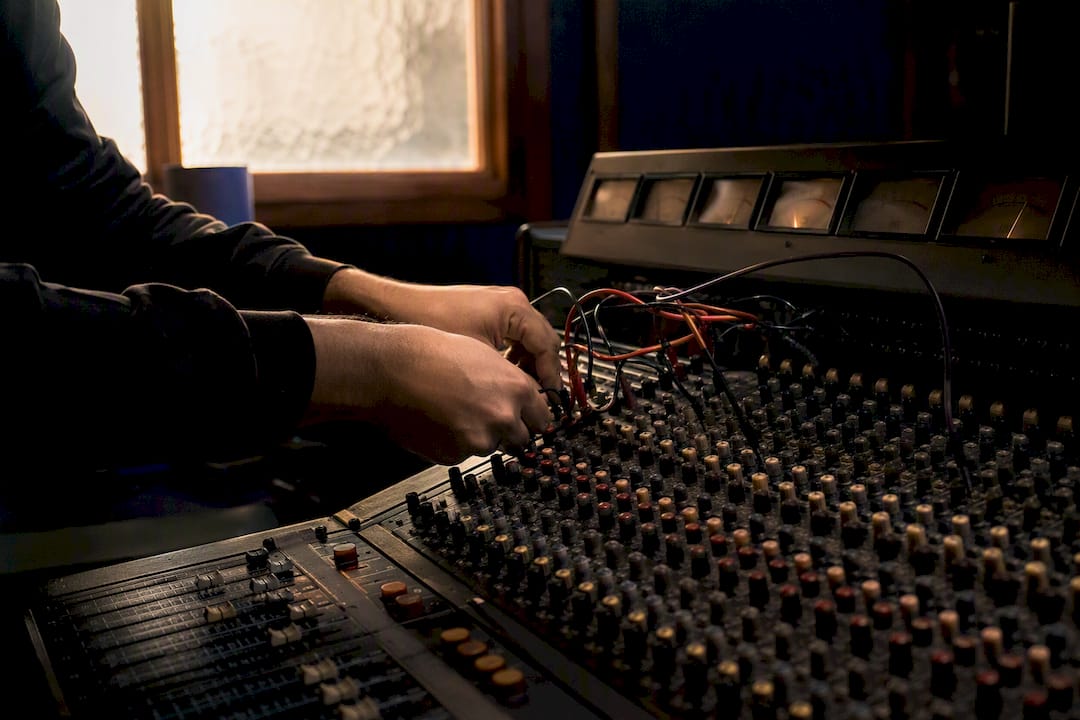
Your producer portfolio must put three things front and center within the first screen a visitor sees: playable audio that proves your ear, clear credits that prove your role, and an obvious way to hire you. Everything else on the page is secondary to that first impression.
- A handful of your best audio examples, playable without a click-through
- Clear credits and role labels on each track (produced, mixed, mastered)
- A visible contact path or booking link, ideally with a starting price
Trust signals matter just as much as the audio itself. A verified streaming number, one short client line, and visible technical detail on a single track (something like “WAV, 44.1kHz”) tell a visitor you’re operating at a professional level before they’ve even hit play.
Pro Tip: Put your single best track first, not your most recent one. Visitors judge your entire catalog by the first fifteen seconds they hear.
Key Takeaways
A producer portfolio converts visitors into clients when it leads with playable proof of skill, clear credit labeling, and a low-friction way to make contact.
| Point | Details |
|---|---|
| Lead with your best audio | Put three to six standout tracks in the first screen, playable without a click. |
| Curate, don’t dump | Show six to twelve strong items plus an archive rather than a full discography. |
| Template every case study | Use hook, role, technical highlight, and result for each portfolio entry. |
| Price transparency filters leads | Listing starting prices on services pages reduces low-budget inquiries. |
| Host for discovery, not just playback | A MyKasu profile pairs your showcase with a network actively posting paid gigs. |
Table of Contents
- What Should a Music Producer Portfolio Include?
- How Should You Structure Your Portfolio for Fast Conversion?
- How Do You Present Each Portfolio Example?
- What Technical and Playback Details Matter Most?
- Should You Specialize or Show Range in Your Portfolio?
- How Often Should You Update and Promote Your Portfolio?
- Where Should You Host Your Producer Portfolio?
- What I’ve Learned Assembling My Own Portfolio
- Build Your Producer Profile Where the Work Actually Is
- Sources
What Should a Music Producer Portfolio Include?
A producer portfolio for music professionals needs a mix of finished work and proof of process, not just a pile of tracks. Build the checklist in this order of priority:
- Finished, released tracks — your strongest, most polished work first
- Final mixes or masters you’re proud to put your name on
- Before/after mix comparisons that show the improvement you made
- Stems, available on request rather than posted publicly
- A beat pack or beat store highlight reel, if that’s part of your business
- Two or three short case studies with a problem, approach, and result
- Credits and placements, labeled by role
- A short client testimonial or two
- A services and pricing section
On quantity: fewer than five items looks thin, but more than twelve buries your best work. Recommendations across the industry vary between three and twelve items, with most agreeing that a tight six to twelve track showcase, backed by a deeper archive, outperforms a full discography dump. For metadata, show the role (producer, mixer, mastering engineer), release date, and BPM or key where it’s relevant to the genre. Streaming numbers help too, when they’re real and current.
How Should You Structure Your Portfolio for Fast Conversion?
Structure decides whether a visitor listens for ten seconds or ten minutes. A homepage should state who you are and what you make in one sentence, then move straight into your best work. That opening line, paired with a concise set of strongest tracks and an obvious contact path, is what turns a browser into a lead.
Build these sections, roughly in this order:
- Home hero: one sentence, embedded player, contact button
- Selected works: your curated top tracks
- Case studies: two or three deeper examples
- Credits: a scannable list by role
- Services and pricing: what you sell and what it starts at
- Testimonials: short, specific, attributed
- Contact: form or direct link, always visible
Reduce friction wherever you can. A sticky contact button, direct-play embeds instead of external links, and simple filters by role or genre keep visitors moving forward instead of hunting for information. Tag playlists by function (produced, mixed, mastered), by genre, or by mood or use case, so a film music supervisor and a rapper looking for beats both find their lane fast.
How Do You Present Each Portfolio Example?
Every portfolio item needs a template, or you’ll write a different style of caption for each track and confuse visitors about what they’re hearing. Use this four-part structure for each entry:
- The hook: one sentence on the project (“Debut single for an indie R&B artist, streamed on Spotify’s New Music Friday”)
- The credit: your exact role (“Produced and mixed”)
- The technical highlight: what you actually did (“Rebuilt the low end with parallel compression to fix a muddy bass”)
- The result: a metric, placement, or short client quote
Use before/after audio and stem downloads specifically for mixing and mastering work. A/B comparisons demonstrate technical improvement in a way that a finished track alone can’t because the listener hears the exact problem you solved.
For microcopy, keep credit lines factual and link straight to the streaming page: “Produced by [Your Name] — listen on Spotify,” not a vague “worked on this record.”
Pro Tip: Write your case-study hook before you write anything else. If you can’t summarize the project in one sentence, the case study probably needs a stronger angle.
What Technical and Playback Details Matter Most?
Visitors notice sound quality and file handling faster than they notice design. Keep preview clips between 30 and 60 seconds, focused on the strongest section of the track, not the intro. Full-track downloads and stems belong behind a request form or a paid delivery step, not sitting open on the page.
- Use MP3 at 320kbps for embedded players
- Offer WAV or AIFF for downloads and paid delivery
- Display bitrate and sample rate on at least one flagship track
- Keep loudness consistent across your playlist so nothing jumps out at the wrong volume
- Label stems clearly (drums, bass, vocals, FX) if you offer session exports
Before/after demos and stem availability specifically persuade clients hiring for mixing or mastering work, since they can hear the technical difference rather than take your word for it.
Pro Tip: Run your whole playlist through a loudness meter before publishing. A portfolio where one track hits noticeably louder than the rest reads as sloppy, even if the mix itself is clean.
Should You Specialize or Show Range in Your Portfolio?
Start by naming the roles you actually want to be hired for, then pick examples that prove you can do that job well. A mixing engineer chasing mix clients gains nothing from stacking the page with beats they produced years ago.
- Build a primary set of multiple items tied directly to your target work
- Move everything else into an archive or “more work” link
- Specialize when you’re targeting a niche (mixing engineer, trap beatmaker, film scoring)
- Show range only when you’re deliberately positioning as a generalist for hire
- Tag cross-genre work clearly by role and genre so it doesn’t read as inconsistency
An up-to-date, curated portfolio increases your odds of landing studio work or freelance gigs specifically because it shows a clear style, not a scattered résumé. If you’re still defining what makes your work distinct, it’s worth thinking through your signature sound before you decide what goes on the front page.
How Often Should You Update and Promote Your Portfolio?
A portfolio that never changes stops converting. Update your top tracks after every release, refresh case studies monthly, and check your contact form weekly to make sure it’s actually working.
- Weekly: check contact form submissions and reply times
- Monthly: rotate a track based on what’s actually getting engagement
- After each release: add the new track, retire your weakest current one
For promotion, clip 15 to 30 seconds of your best work for social, send targeted messages with a direct portfolio link instead of a generic bio link, and embed your portfolio link in every email pitch you send. Listing starting prices on your services page cuts down low-budget inquiries and speeds up booking conversations considerably.
Pro Tip: Add a budget and timeline field to your contact form. It filters out tire-kickers before you waste a call on them.
Where Should You Host Your Producer Portfolio?
Each hosting option trades off differently, and most working producers end up using more than one.
- Personal website: full control over branding and SEO, but you handle all the traffic-driving yourself
- Streaming embeds (SoundCloud, Spotify, YouTube): fast to set up and easy to share, but you’re limited to playback, not networking
- A dedicated music-industry platform: built for discovery, collaboration, and gig posting rather than just playback
A personal site maximizes control while streaming embeds add convenience, but neither one is built to connect you with collaborators or surface paid work. That’s the gap MyKasu fills. It’s built specifically around producer needs: structured credit fields by role, a network of musicians and engineers actively looking to collaborate, and a gig board where opportunities post directly to people who make music for a living.
The strongest setup, for most producers, pairs a personal site or embedded player for branding with a MyKasu profile for discovery and outreach. One gives you control. The other gives you people who are actually looking to hire.

What I’ve Learned Assembling My Own Portfolio
Picking the six front-facing tracks is the hardest part, and it never gets easier with more material to choose from. I lean toward variety within a narrow lane: one radio-ready mix, one technically ambitious project, one collaboration that shows I work well with other people. Captions stay short, one sentence, no adjectives doing the heavy lifting.
On metrics, I show streaming numbers only when they’re strong enough to help, not out of habit. Full discography versus curated showcase is a real trade-off, and I side with curated every time, even when it means leaving good work off the page.
A cold outreach message I’d actually send: “Hey, I produced/mixed [track] for [artist], link here [portfolio link]. Open to work on [specific project type] if you need someone.” Short, specific, and it qualifies itself.
Build Your Producer Profile Where the Work Actually Is
A personal site shows off your sound. It doesn’t introduce you to the vocalist who needs a beat by Friday or the label A&R scouting for a mixer. MyKasu closes that gap by putting your showcase and your network in the same place.
- Structured credit fields that display your exact role on every project
- A gig board where paid opportunities post directly to producers, not general freelancers
- Audio embeds built for showcasing tracks, stems, and case studies without a third-party player
If your portfolio is ready but your contact form has been quiet, the fix might not be your mixes. It might be where you’re standing. Create a MyKasu profile and put your work in front of people actively looking to hire.
Sources
- What clients want to see in your production portfolio — RouteNote blog
- How to Build a Producer Portfolio and Website in 2026 — Tools 4 Music
- How to Build a Music Producer Portfolio — The Ghost Production