

A session musician’s fee typically falls within a broad typical range per song for a basic part, per hour outside union scale, and per person for a full studio day. Union sessions run higher: the Musicians’ Union BPI agreement and AFM scale tables set formal minimums, then add pension and health contributions that push the real cost well past the sticker rate. Non-union buyout deals, where the musician takes a flat fee and signs away future royalties, dominate independent and DIY projects because they’re simpler to budget.
Here’s how that breaks down in practice:
- Entry-level or remote player: a typical lower per-song fee, often a flat buyout
- Working pro (touring or heavy studio credits): a moderate per-song or hourly fee
- Top-tier session player or contractor: a higher per-song fee, sometimes more for arranging or leading a section
- Union scale session (AFM/MU): rates vary by market and instrument, plus mandatory pension and health add-ons
Quick stat: A basic three-hour AFM-scale session, before pension and health contributions are added, generally runs in the low hundreds of dollars per musician, according to Tools 4 Music’s 2026 breakdown. Keep reading for the full reference table, worked budget examples, and what actually drives a quote up or down.
Key Takeaways
Session musician rates in 2026 typically run $50 to $200 per song non-union, with union scale sessions adding pension, health, and reuse fees on top.
| Point | Details |
|---|---|
| Set your rate anchor first | Use the $50-$450 per-song tiers to pick the nearest match before requesting quotes. |
| Union scale costs more than it looks | AFM and Musicians’ Union sessions add pension, health, and reuse fees beyond the base pay rate. |
| Usage rights change the price | Clarify buyout versus session-only before recording, since sync and commercial rights raise fees significantly. |
| Preparation cuts real costs | Sending charts and guide tracks in advance shortens session time and lowers the final bill. |
| Vet talent on a focused network | MyKasu lets producers check verified credits and sample work before booking, reducing hiring risk. |
Table of Contents
- How much do session musician rates really run?
- What do union pay scales actually require?
- What drives a session player’s fee up or down?
- How does session booking actually work?
- What should you budget for common recording scenarios?
- How do you build a real project budget?
- What belongs in a session musician contract?
- How can you cut costs without cutting quality?
- How do you find vetted session musicians efficiently?
- What do experienced producers wish they’d known sooner?
- Where can you find reliable session musicians fast?
- Frequently Asked Questions
- Sources
How much do session musician rates really run?
Rates cluster into four rough tiers, and knowing which tier fits your project saves you from either overpaying or getting a rushed, underprepared performance. The numbers below reflect U.S. market norms compiled across multiple 2026 industry guides, cross-checked against the Bureau of Labor Statistics’ wage data for musicians and singers as a baseline for professional compensation.
| Tier | Per Song | Per Hour | Per Day |
|---|---|---|---|
| Entry / remote | typical lower-range fee | typical lower hourly rate | typical lower full day rate |
| Intermediate / working pro | moderate per-song fee | moderate hourly rate | moderate full day rate |
| Professional (touring/credits) | higher per-song fee | higher hourly rate | higher full day rate |
| Elite / in-demand session player | top-tier per-song fee | top-tier hourly rate | top-tier full day rate |
Instrument matters too. A rhythm guitar part often sits at the low end of a tier, while a lead vocalist, a string arranger, or a horn section leader commands a premium because the part carries more of the song’s identity. Tools 4 Music’s instrument breakdown shows drums and bass tracking close to guitar rates, while strings and horns often price per player, then get bundled through a contractor.
Here’s a worked example. Say you need guitar, bass, and drums on one song, all intermediate-tier players working remotely:
- Guitar: $150 per song
- Bass: $125 per song
- Drums: $175 per song (often the priciest, since it usually requires the most setup time or a paid studio room)
That’s $450 for a full rhythm section on one track, before you add vocals, mixing, or mastering.
Pro Tip: Ask for a flat per-song rate whenever the part is simple and the musician records remotely. Hourly billing makes sense for in-person sessions where you’re directing takes live, but it punishes you when a remote player nails the part in fifteen minutes and still bills a full hour.
What do union pay scales actually require?
Union agreements set a floor, not a ceiling, and that floor comes with extra costs most independent artists don’t budget for. The Musicians’ Union BPI agreement publishes Non-Classical recording session fee scales in the UK, covering base session pay and overtime rates that any label or producer signed to the agreement must honor. In the U.S., the American Federation of Musicians negotiates similar scale minimums through its locals, and territory-specific unions like the Nashville Musicians Association publish their own updated master scale figures for that market.
What catches most independent producers off guard is the add-on cost:
- Pension and health contributions — AFM-scale sessions typically require employer-side pension and health payments on top of the musician’s fee, documented through AFM-EPF.
- “New use” or reuse payments — if a union recording gets used somewhere new (a film, an ad, a rerelease), the musician may be owed an additional fee.
- Overtime multipliers — union scale sessions often carry strict per-hour overtime rates once a session runs past its contracted block.
Most independent artists and small labels skip union scale entirely and negotiate a flat buyout instead. The tradeoff is real: you avoid pension contributions and reuse payments, but the musician takes on more career risk by giving up future compensation if the track blows up. SupremeTracks’ 2026 guide notes buyout deals now dominate the independent market for exactly this reason.
What drives a session player’s fee up or down?
Experience is the obvious lever, but it’s rarely the biggest one. A player with major label credits will charge more than a newcomer, sure. But the details of the job usually move the number more than the resume does.
Primary rate drivers:
- Instrument rarity (a pedal steel player costs more than a rhythm guitarist because there are fewer of them)
- Arrangement complexity (a written string chart costs more to execute than three power chords)
- Turnaround time (rush jobs, especially same-day, often carry a surcharge)
- Number of revision rounds requested after the first take
- Usage rights (session-only versus a full buyout that includes commercial release)
- Travel and accommodation, if the session isn’t remote or local
Secondary factors that shift the quote:
- Whether the player needs to sight-read a chart cold or gets a demo and lyrics in advance
- Doubling on multiple instruments in one session
- Whether specialized gear or amps need to be rented
- Whether the musician delivers raw stems or a rough mix
Pro Tip: *If your player doubles on two or three instruments, negotiate a bundled rate rather than paying full price per instrument.
Before you set a rate, run through this checklist: 1) How complex is the part? 2) Does the player need advance materials? 3) Is this session-only or a full buyout? 4) Is travel involved? 5) What’s your actual deadline?
How does session booking actually work?
Standard sessions run in blocks, most commonly three hours, with four-hour and eight-hour (full day) blocks also common for bigger projects. A “long session” typically means anything past the standard block, and most union agreements and many freelance players charge an overtime rate, often time-and-a-half or double time, once you go past the contracted window.
Three rate structures show up repeatedly:
- Hourly — best for in-person sessions where you’re actively directing takes and don’t know exactly how long a part will take to nail
- Flat per-song or per-track — best for remote work or simple parts where the scope is clear upfront
- Day rate — best when you need one player for multiple songs in a single sitting, since it usually beats paying per-song across five or six tracks
A retainer arrangement, where you pay a musician a set monthly fee for ongoing availability, only makes sense for artists with a steady release schedule, not one-off projects.
Here’s how overtime math plays out. A guitarist booked for a standard $150 three-hour session who runs an extra hour at time-and-a-half might add roughly $75 to the bill, on top of whatever your engineer or studio room charges for that same extra hour. Multiply that across three or four players, and a session that runs long can quietly double your day’s labor cost.
What should you budget for common recording scenarios?
Real numbers help more than tiers alone. Here are typical budgets for scenarios independent producers hire for constantly, based on tiered ranges reported across SupremeTracks, Tools 4 Music, and Orphiq.
A few things push these numbers higher across the board: travel outside a player’s home market, extra takes beyond what was agreed, or extending usage rights after the fact (say, licensing a track for a commercial after it was recorded session-only).
Build your own quick estimate with this template:
- List every instrument or vocal part you need
- Assign a rate tier to each player based on experience and complexity
- Add 10-15% contingency for revisions or an extra take
- Add contractor or arranger fees if you’re booking three or more players through one person
- Confirm whether the quote includes buyout rights or session-only
How do you build a real project budget?
Take a single song with guitar, bass, and drums, all intermediate tier, all remote. Guitar at $150, bass at $125, drums at $175 gets you to $450 in player fees. That’s your per-song baseline for a simple three-piece arrangement.
Now scale that to a five-song EP:
- Multiply your per-song player cost by five: $450 x 5 = $2,250
- Add contingency across the whole project rather than per song, usually 10% of the total: $225
- Add a buyout premium if you want full commercial rights on all five tracks upfront, commonly 20-40% above session-only pricing depending on the player
- Factor in mixing and mastering separately. A resource like IndepthJayBeats’ mixing and mastering services can give you a sense of what that stage typically adds per track once the performances are locked
- Total before mixing/mastering: roughly $2,700 to $3,300 for the EP’s musician costs, depending on buyout terms
Copy this worksheet structure for any project: parts needed, rate per part, contingency, buyout premium, total. It takes ten minutes and saves you from a mid-session budget surprise.
What belongs in a session musician contract?
Verbal agreements cause more budget disasters than bad rates do. Get these items in writing before anyone hits record:
- Scope of work (exactly which parts, how many songs)
- Deliverables (raw stems, mixed stems, or both)
- Turnaround time
- Buyout versus session-only usage
- Credit (album credit, liner notes, streaming metadata)
- Number of revision rounds included in the quote
- Payment terms and timing (deposit, on delivery, net 30)
- Cancellation or rescheduling fees
Usage rights are where budgets quietly explode. A session-only fee covers the initial recording, but if you later want to license the track for a commercial, sync it to a film, or push it to a new format, many musicians (particularly union players) are owed a separate “new use” fee under agreements like the Musicians’ Union BPI agreement. If you know you’ll want to pitch a track for sync down the road, ask for a full buyout upfront. It costs more now but avoids a renegotiation later when you have less leverage.
Quick stat: Orphiq’s negotiation guidance notes that buyout premiums for full commercial rights commonly run well above session-only pricing, which is why clarifying usage terms before the session, not after, protects both sides.
A simple email checklist covering scope, deliverables, buyout terms, and payment schedule takes five minutes to draft and prevents most disputes before they start.
How can you cut costs without cutting quality?
Preparation is the cheapest thing you’ll ever do for a session budget. Send charts, a click track, and a guide vocal before the date, and you’ll cut studio time (and therefore cost) by a meaningful margin, since the player isn’t learning the song on the clock.
A few other moves that actually work:
- Record parts remotely when the arrangement doesn’t require live interaction between players
- Group multiple songs into one day block with the same player instead of booking separate sessions
- Hire a multi-instrumentalist for a project needing several complementary parts instead of three separate specialists
- Pay a skilled editor to comp takes rather than paying a player for endless extra passes
A cheaper player isn’t always a cheaper project. If someone needs six takes to nail what a pricier player gets in two, you’ve paid for the extra studio time and lost the schedule advantage too.
Pro Tip: If you need a rush turnaround, offer to trade a reduced buyout or extra credit for a faster delivery instead of just paying a flat rush surcharge. Many players will take a fair trade over a straight cash premium, especially for a project they’re excited about.
How do you find vetted session musicians efficiently?
Generic freelance marketplaces bury good players under a flood of unqualified applicants, which is exactly the friction a music-focused network is built to remove. On a platform like MyKasu, you search by actual credits and instrument specialty, listen to verified audio samples tied to a real profile, and message directly to confirm scope and rate before booking anything.
The workflow looks like this:
- Search by instrument, genre, or specific credits
- Review sample tracks and confirm the sound matches your project
- Check listed rates, availability, and turnaround expectations
- Message directly to lock scope, usage rights, and payment terms
Before booking anyone, check for: sample quality that matches your genre, verifiable past credits, a clear gear list, and a stated turnaround window. A profile missing any of those four is a red flag worth a follow-up question before you commit money. For a broader look at producer-side hiring resources, ARTEEST’s producer directory is another useful stop when you’re comparing workflow options.
What do experienced producers wish they’d known sooner?
Budgets fall apart from small oversights, not big miscalculations. Here are the rules of thumb worth adopting before your next session.
Always pad one extra hour per player into your schedule, because sessions run long more often than they run short. Prefer per-song flat rates for remote work, since hourly billing on a remote job just invites disputes over how long something “should” take. Expect a buyout premium the moment sync or commercial licensing enters the conversation. Bundle multi-instrumentalists rather than hiring specialists for every single part. Get usage terms in writing before the first note gets recorded, not after you’ve heard the final mix and fallen in love with it.
The most common mistake: producers agree to a session-only rate, love the result, then get blindsided by a “new use” fee when they want to license the song months later. That fee negotiation happens from a much weaker position after the fact than it would have upfront, when the player was still deciding whether to take the gig at all.
Where can you find reliable session musicians fast?
Sorting through generic gig-posting sites and cold-messaging strangers on general social platforms wastes hours you could spend actually making music. MyKasu is built specifically for that gap: a dedicated network where musicians, producers, and engineers already show verified credits, sample work, and real availability in one place instead of scattered across five different apps.
What that gets you:
- Verified portfolios you can actually vet before you spend a dollar
- Direct messaging to confirm rate, scope, and turnaround before booking
- A searchable pool organized by instrument, genre, and credits
- A community built around paid gig opportunities, not generic freelance listings
If your next project needs a guitarist, a string arranger, or a mixing partner, start browsing profiles on MyKasu and get your session booked with someone whose work you’ve actually heard first.
Frequently Asked Questions
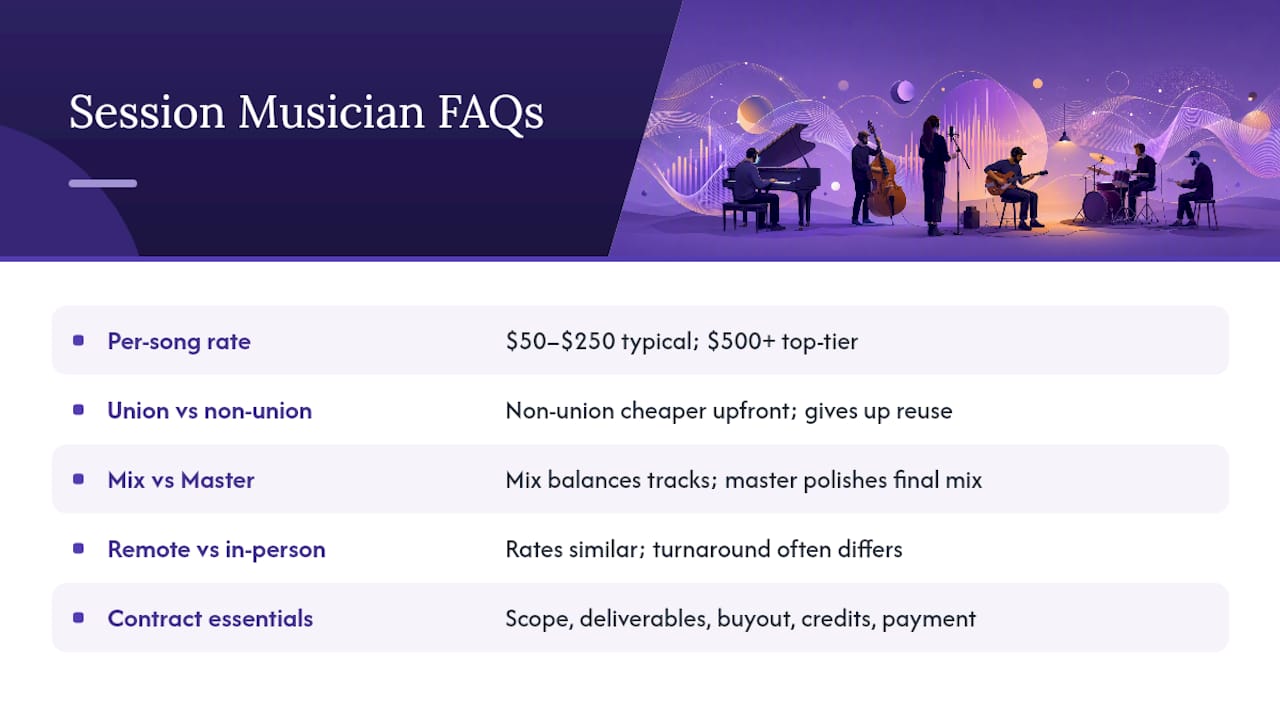
How much do session musicians charge per song on average? Most independent projects pay $50 to $250 per song for a single instrument part, depending on experience and complexity. Top-tier players or those handling lead vocals and arrangements can charge $500 or more per song.
Is it cheaper to hire union or non-union musicians? Non-union buyout deals are usually cheaper upfront because they avoid mandatory pension and health contributions required under AFM and Musicians’ Union agreements. The tradeoff is that the musician gives up future reuse or new-use payments, which is why many are willing to accept a flat, lower fee.
What’s the difference between a mixing engineer and a mastering engineer for budgeting? A mixing engineer balances individual tracks into a cohesive stereo file, while a mastering engineer polishes that finished mix for loudness, tone, and playback consistency across platforms. Budget for both separately, since a good mastering engineer is a final quality step, not a substitute for mixing.
How do I find a mastering engineer without overpaying? Look for verified sample work in your specific genre rather than general engineering credits, since mastering approaches vary widely by style. Platforms with verified portfolios let you hear an engineer’s actual finished work before committing to a rate.
Do remote session musicians charge less than in-person players? Remote rates are often comparable or slightly lower for simple parts, since the player saves studio booking time and travel, but complex arrangements or tight deadlines can offset that savings. The bigger difference is usually turnaround speed rather than raw price.
What should I include in a session musician contract? Cover scope of work, deliverables, turnaround time, buyout versus session-only usage, credit, revision rounds, and payment terms at minimum. Getting these in writing before the session prevents most billing disputes after the fact.
Sources
For territory-specific figures or the most current scale updates, check the primary sources directly rather than relying solely on secondary guides:
- Musicians and singers - Occupational Outlook Handbook - BLS
- AFM-EPF
- How Much Do Session Musicians Charge in 2026? | Tools 4 Music Blog
Union scale pages get updated periodically, so always check the current posted date on the local union’s page before finalizing a union-scale budget.